

IELTS process diagrams can be challenging for some students to describe because, unlike charts and graphs, they don’t provide data to compare. Instead, in an IELTS process chart, you will see a series of steps or a cycle that you have to explain in your own words. So, to score high in this type of question, you have to follow a template and use good vocabulary along with other tips. In this blog, you will see expert-written tips, a template, and sample questions with answers. Let’s start with a highly effective template.
 Key Takeaways
- An IELTS process diagram shows stages or a cycle, so you describe the sequence rather than compare data.
- Use four paragraphs, an introduction, an overview with the number of stages and the start and end points, and two body paragraphs.
- Use the passive voice for man-made processes and the active voice for natural ones.
- Group small steps together and vary your sequencing words instead of repeating then and after that.
- Describe only what the diagram shows, in the present simple, and write at least 150 words.
Template to Score High in IELTS Process Diagram
Use this four-paragraph structure to cover every scoring criterion.
Paragraph 1: Introduction (1-2 sentences)
Paraphrase the question by changing the verbs and nouns without changing the meaning.
- The diagram illustrates / The illustration shows / The given process explains…
- …how [topic] is produced / the way in which [topic] is carried out / the stages involved in [topic].
Paragraph 2: Overview (2 sentences)
Many students skip this paragraph, and it costs them marks. Mention the total number of stages and the starting and ending points.
- Overall, the process consists of [number] distinct stages, beginning with [first step] and ending with [final product].
- It is clear that the process is linear/cyclical, and [one notable feature, such as machinery or a natural stage].
Paragraph 3: Body 1 (first half of the process)
Describe the first set of stages in order, using sequencing words naturally.
- To begin with, / At the first stage, / The process starts when…
- Following this, / Once this is complete, / Subsequently…
Paragraph 4: Body 2 (second half of the process)
Continue from where you stopped.
- After that, / Next, / Then…
- In the final stage, / Finally, the finished product is…

Experience exam-style practice and get AI-powered insights to understand where you stand.

- Discover your strengths and areas to work on.
- Use detailed feedback to guide your next steps.
Tips for Scoring 8+ Bands in Process Chart IELTS
Mix active and passive voice
- Most man-made processes use the passive, such as the clay is heated or the water is filtered. But if the diagram shows a natural process or a living creature, the active works better, as in the larvae feed on leaves. Examiners like to see that you can switch.
Group steps instead of listing them one by one
- Writing “first, then, then, then” for nine stages sounds mechanical. Combine small steps, for example, the grapes are harvested, washed and crushed before the juice is extracted. This shows grammatical range.
Use time connectors beyond the basics
- Try while this is happening, prior to this, once the mixture has cooled, as soon as and at the same time. They add flow and show you can handle complex sentences.
Use precise vocabulary
- Use specific and appropriate vocabulary to express your ideas clearly and accurately. Avoid repeating common words. Replace make with produce, manufacture or generate. Replace put with transfer, place or deposit. Replace get with obtain or extract.
Use nominalization sparingly
- Use nominalization only when it makes your sentences clearer and more concise. Avoid excessive use of nouns formed from verbs, as it can make your writing sound unnatural or unnecessarily complicated. A phrase like the extraction of juice is followed by its filtration sounds academic, but one or two in the whole answer is enough.
Write 170-220 words
- The minimum is 150, but a slightly longer answer lets you describe every stage without rushing. Going far beyond 220 only eats into the time you need for Task 2.
Check the diagram for labels
- Temperatures, durations, machines and raw materials are often written on the picture. A detail like heated at 1,450°C for two hours shows you studied the diagram carefully.
Stay objective
- No opinions, no assumptions, and no information that is not in the diagram. If the picture doesn’t explain why something happens, you don’t either.
Keep your tenses consistent
- Man-made processes use the present simple. Only switch to the past if the diagram clearly shows a historical event, which is very rare.
Know Your Strengths. Find Your Gaps. Prepare Smarter.
- Understand Your Performance- Identify strengths and areas that need more attention.
- Track Your Progress – Review your performance across IELTS sections.
- Focus on What Matters- Use your feedback to plan more targeted preparation.
IELTS Process Diagram Sample Questions with Answers
The ten samples below cover man-made processes, natural cycles and flow charts. For other Task 1 question types, see our IELTS Writing Task 1 sample answers.
Sample Question 1
Answer:
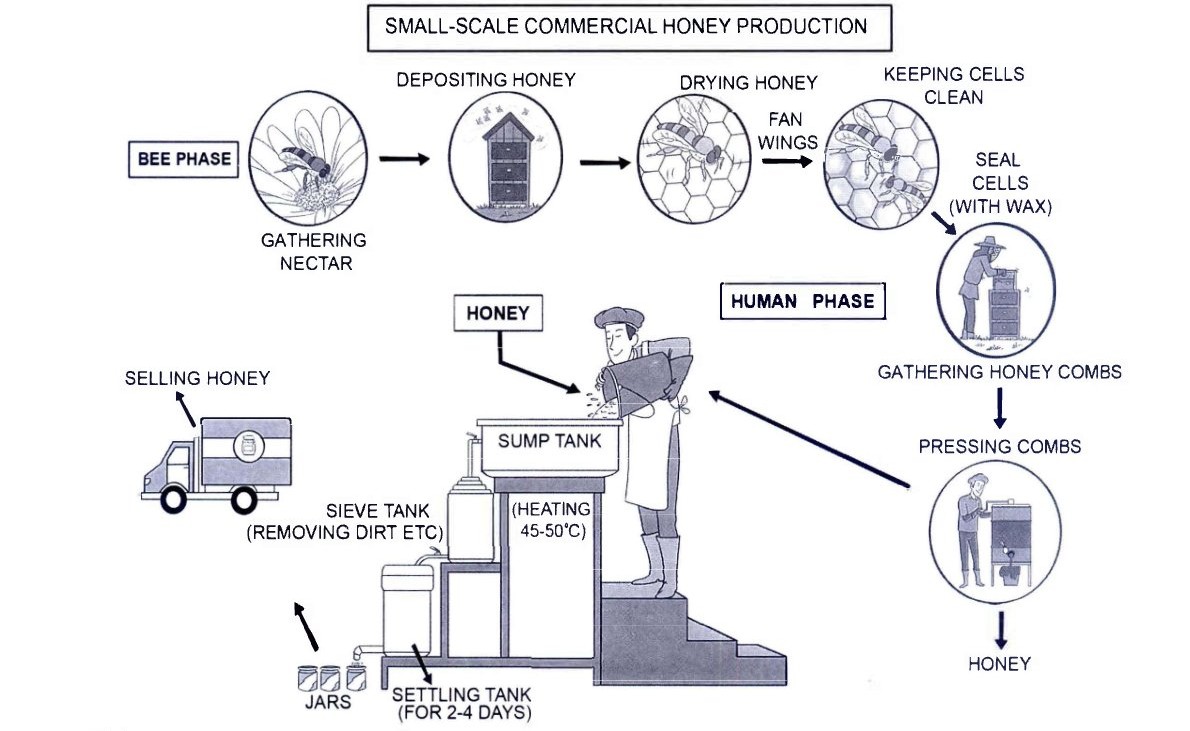
The diagram illustrates the various stages involved in small-scale commercial honey production, from the collection of nectar by bees to the processing and selling of the final product.
Overall, the process consists of several stages, which can be divided into two main phases, the bee phase and the human phase. It begins with bees collecting nectar from flowers and ends with the finished honey being packed into jars and transported for sale.
To begin with, bees gather nectar from flowers and deposit it into the cells of a beehive. Following this, they dry the honey by fanning their wings. At the same time, they keep the cells clean before sealing them with wax. Once the honeycombs are ready, humans take over the process by collecting them from the beehives. Subsequently, the honeycombs are pressed to extract the honey.
In the next stage, the extracted honey is transferred into a sump tank, where it is heated to a temperature of 45–50°C. After that, it passes through a sieve tank to remove dirt and other impurities. The filtered honey is then stored in a settling tank for two to four days. Finally, the purified honey is poured into jars and transported by truck for commercial sale.
Sample Question 2
Answer:
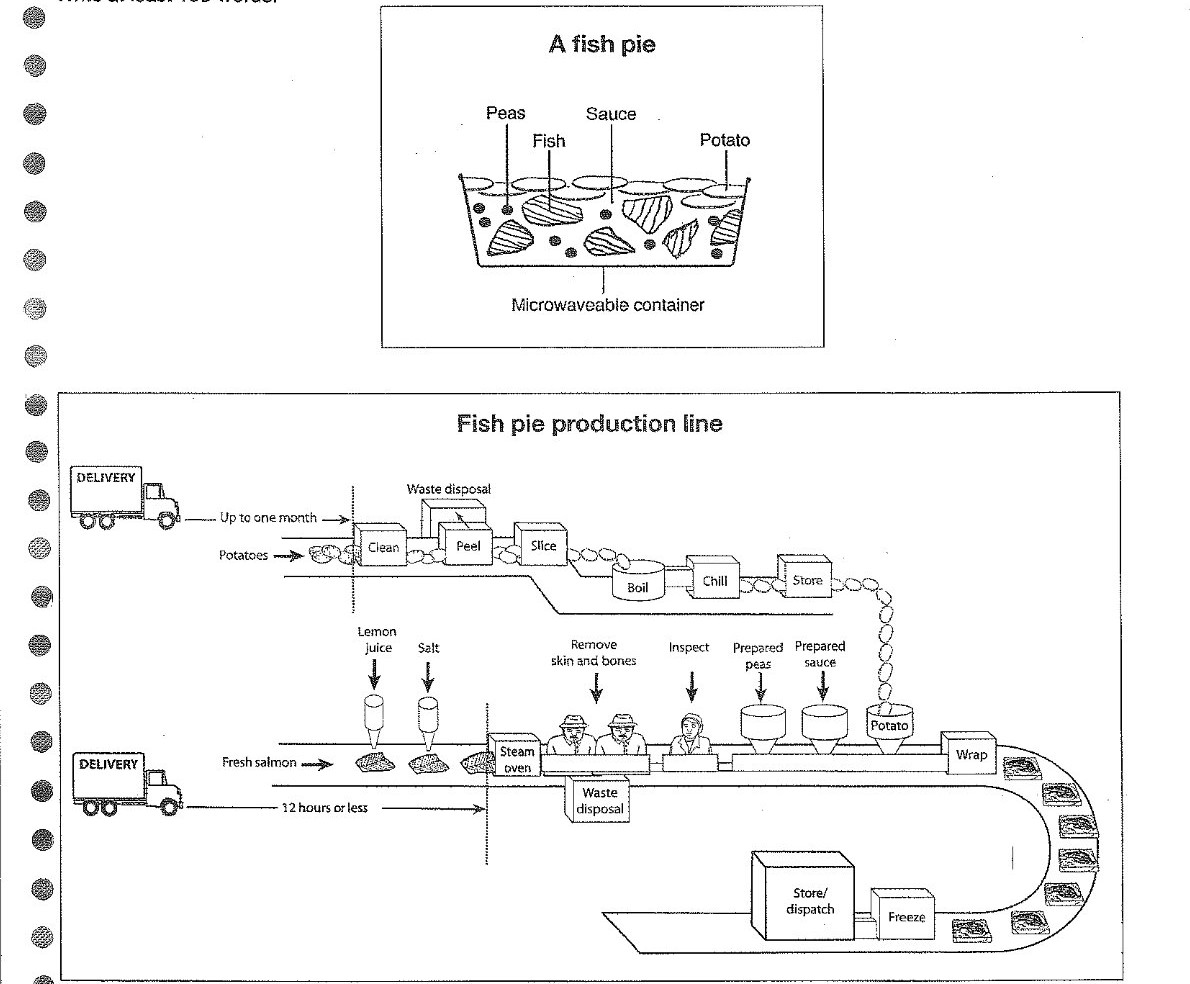
The given illustration provides information about the different stages involved in the large-scale production of fish pies, including the preparation of ingredients and the packaging of the final product.
Overall, the production process involves several stages, with potatoes and fresh salmon being prepared separately before they are combined with other ingredients. It starts with the delivery of raw materials and finishes with the freezing, storage and dispatch of the completed fish pies.
Initially, potatoes are transported to the factory, where they can be stored for up to one month. They are then cleaned, peeled and sliced before being boiled, chilled and stored. Meanwhile, fresh salmon is delivered within 12 hours or less. Lemon juice and salt are added to the fish before it is cooked in a steam oven. After cooking, workers remove the skin and bones, and the fish is inspected to ensure its quality.
Following this, the prepared salmon moves along the production line, where peas, prepared sauce and potatoes are added. The mixture is then placed in suitable containers and wrapped. In the final stages, the fish pies are frozen and transferred to the storage and dispatch section before being distributed.
Sample Question 3
Answer:
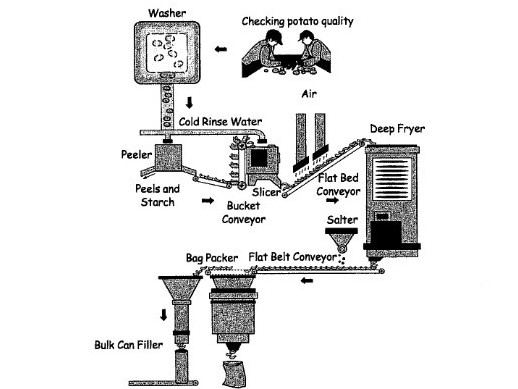
The diagram illustrates the process of manufacturing potato chips, from the initial inspection and washing of raw potatoes to the final packaging of the finished product.
Overall, the process consists of approximately ten main stages, beginning with the quality inspection of potatoes and ending with the filling of containers. It is a linear process involving several machines, conveyors and other equipment to transform raw potatoes into packaged potato chips.
To begin with, the potatoes are manually checked by workers to ensure that they are of suitable quality. They are then transferred to a washing machine, where they are cleaned using cold rinse water. Following this, the washed potatoes pass through a peeler, which removes their skins and starch. The waste materials are separated and discarded. Subsequently, the peeled potatoes are cut into thin slices using a slicing machine. These slices are then carried along a conveyor belt, where air is used during the process before they are transferred to a deep fryer.
In the next stage, the potato slices are deep-fried until they become crispy. After frying, the chips are transported along a flat-bed conveyor belt, where salt is added to improve their flavor. They are then moved to a bag-packing machine, which places the finished chips into bags. Finally, the packaged potato chips are transferred to a bulk container-filling machine, where they are collected in larger containers, completing the manufacturing process.
Sample Question 4
Answer:
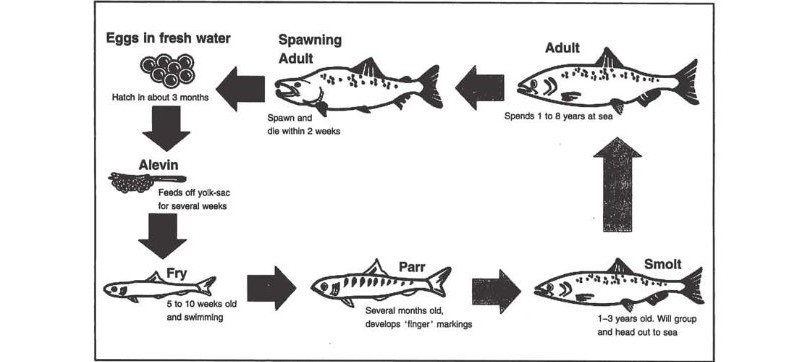
The illustration depicts the life cycle of a salmon, showing the different stages of its development from eggs to a fully grown adult fish and its return to spawning grounds.
Overall, the cycle consists of six main stages, beginning with eggs laid in fresh water and ending with adult salmon returning to spawn. It is a continuous and natural cycle in which salmon undergo several physical changes as they grow and move from freshwater habitats to the sea and back again.
Initially, salmon eggs are laid in fresh water, where they take approximately three months to hatch. The newly hatched fish, known as alevins, feed on their yolk sacs for several weeks. Once this food supply is used up, they develop into fry, which are between five and ten weeks old and begin swimming. Following this, the fry gradually transform into parr. At this stage, they spend several months developing distinctive finger-like markings on their bodies.
In the next stage, parr develop into smolt, a process that takes between one and three years. These young salmon then form groups and migrate towards the sea. After reaching the ocean, they grow into adult salmon and spend between one and eight years there. Finally, the mature fish return to fresh water as spawning adults, where they lay eggs and die within approximately two weeks. The newly laid eggs then hatch, and the life cycle begins again.
Sample Question 5
Answer:
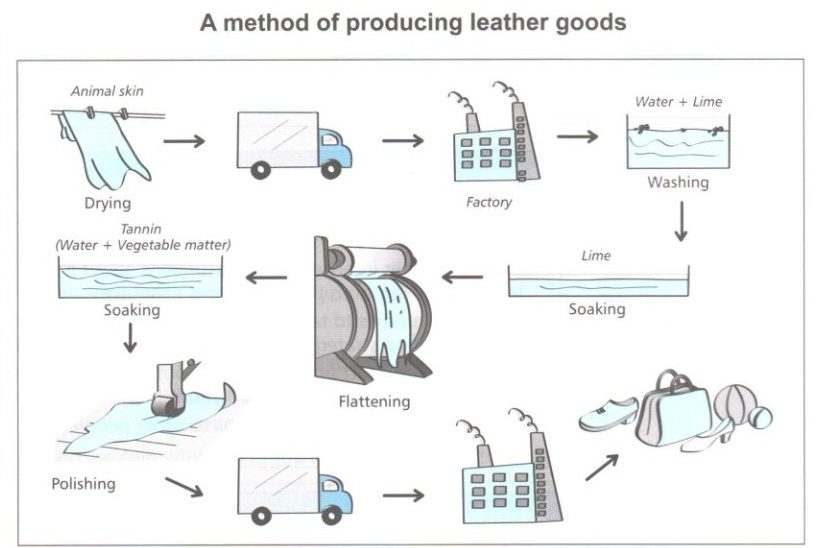
The diagram outlines the various stages involved in the production of leather goods, starting with the preparation of animal skins and ending with the manufacture of different leather products.
Overall, the process consists of approximately ten stages, beginning with the drying of animal skins and concluding with the production of finished leather items. It is a linear manufacturing process that involves several treatments, including washing, soaking, flattening and polishing, before the processed leather is transported to a factory for final production.
Initially, animal skins are hung out to dry before being transported by truck to a factory. On arrival, they are washed in a mixture of water and lime to remove unwanted materials. Following this, the skins are transferred to another container, where they are soaked in lime. Once this stage is completed, the skins pass through a series of rollers, which flatten them into thinner and more uniform sheets.
Subsequently, the flattened skins are soaked again, this time in a mixture of water, tannin and vegetable matter. After the soaking process, the leather is polished using specialized equipment to improve its surface. It is then loaded onto a truck and transported to another factory. In the final stage, the processed leather is used to manufacture a variety of finished goods, including shoes, handbags, jackets and other accessories.
Sample Question 6
Answer:
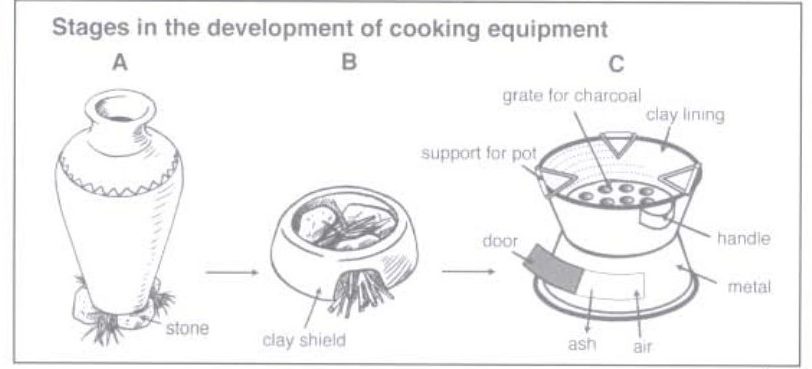
The diagram illustrates the development of cooking equipment, showing how traditional cooking methods gradually evolved into a more advanced and efficient cooking stove.
Overall, the development consists of three distinct stages, beginning with a simple clay cooking vessel placed over a fire and ending with a modern metal stove. It is clear that the equipment becomes increasingly sophisticated, with additional features introduced at each stage to improve the cooking process.
To begin with, the first stage involves a cone-shaped clay vessel with an opening at the top. It is positioned upside down over a small fire, which is fueled by burning wood. A stone is placed near the base to support the structure. Following this, the second stage shows a more developed cooking device, consisting of a rounded clay structure with a protective clay shield. The firewood is placed underneath the equipment, while the cooking pot is positioned inside the upper opening.
In the final stage, the clay structure is replaced by a more advanced metal stove. It features a clay lining on the inside, a grate for charcoal and several supports to hold the cooking pot. In addition, a handle is attached to the side, and a small door allows access to the interior. Finally, the stove includes an opening for air circulation and a separate space at the bottom for collecting ash, making it more practical and convenient for cooking.
Sample Question 7
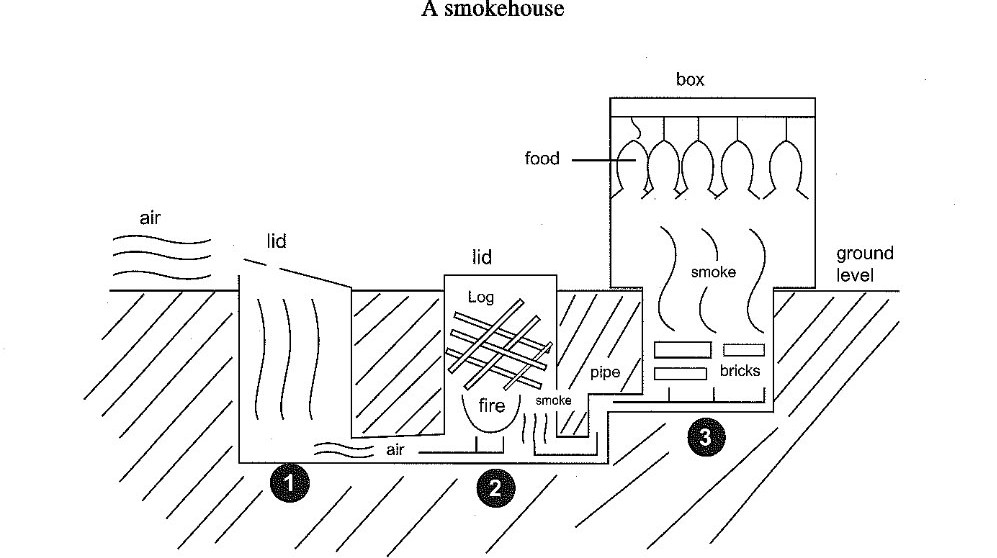
Answer:
The diagram illustrates the process of producing smoked food using a traditional smokehouse, which involves a fire, an underground pipe and a specially designed box.
Overall, the process consists of three main stages, beginning with the preparation of a fire and ending with food being smoked inside a box. It is a continuous process in which air and smoke travel through an underground system before reaching the food.
To begin with, air enters the system through an opening covered with a lid. It then moves underground towards the second section, where a fire is made using logs placed beneath another lid. As the logs burn, smoke is produced and directed through an underground pipe. This pipe connects the fire section to the final chamber.
Following this, the smoke travels through the pipe and enters the third section, which is a box containing several pieces of food hanging from the top. Before reaching the food, the smoke passes through an area containing bricks, which are placed inside the chamber. Finally, the smoke rises inside the box and surrounds the hanging food, allowing it to be smoked. The process continues as fresh air enters the system and helps maintain the fire.
Sample Question 8
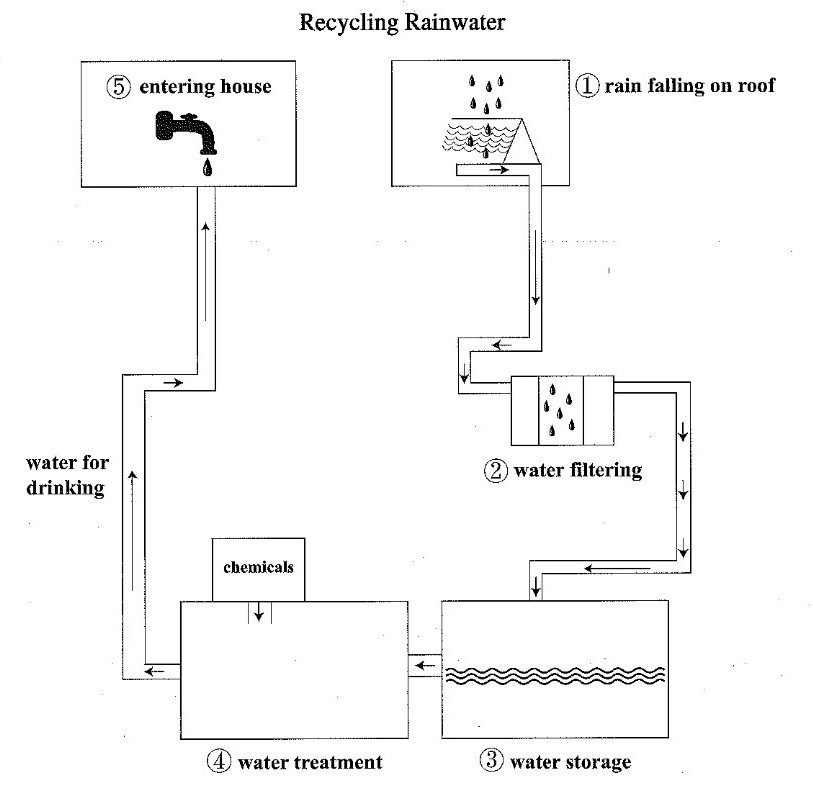
Answer:
The given illustration depicts how rainwater is collected, purified and recycled for household use, particularly for drinking purposes.
Overall, the system consists of five main stages, beginning with the collection of rainwater from rooftops and ending with the supply of purified water to homes. The process involves filtration, storage and chemical treatment to make the water suitable for human consumption.
Initially, rainwater falls onto the roof of a house and is directed into a drainage pipe. It then flows downwards into a filtration unit, where impurities are removed. After being filtered, the water is transported through a pipeline to a large storage tank, where it is temporarily stored for the next stage.
Subsequently, the stored water is transferred to a treatment chamber, where chemicals are added to purify it further. Once this process is completed, the clean water is channeled through another series of pipes towards the house. In the final stage, the treated water travels upwards through the pipeline and comes out of a household tap, making it readily available for drinking and everyday household purposes.
Sample Question 9
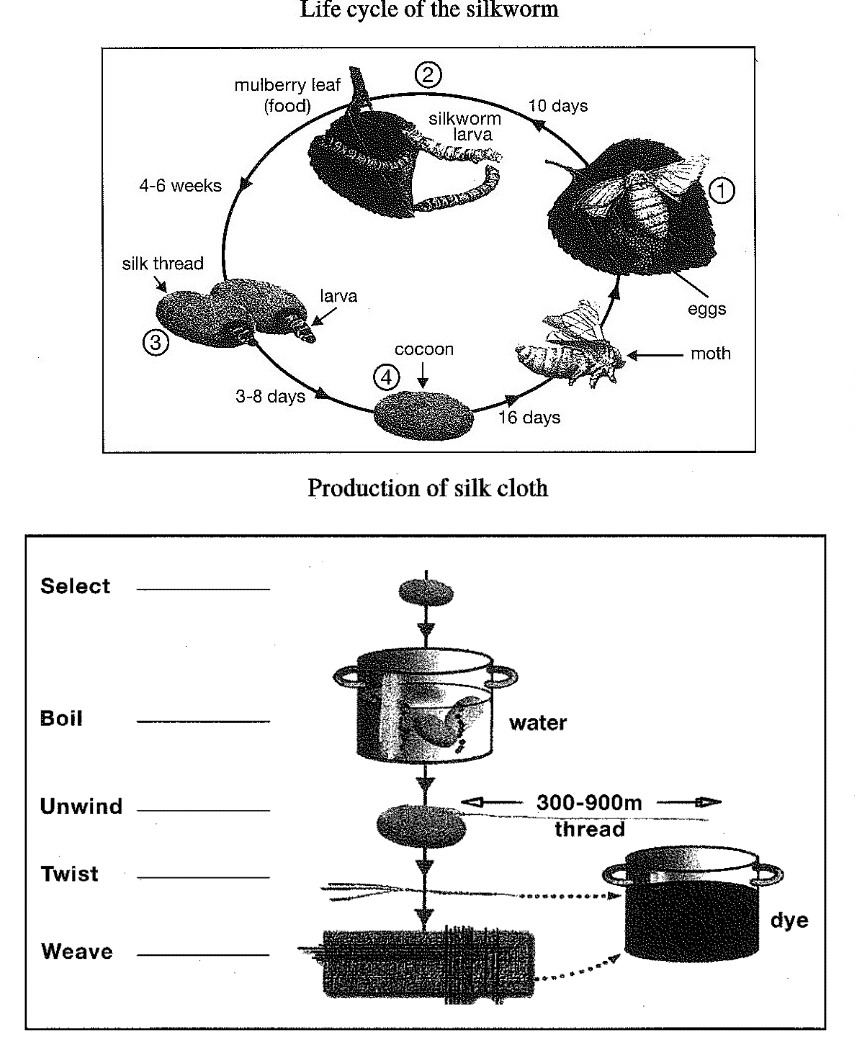
Answer:
The diagrams illustrate the life cycle of a silkworm and the various stages involved in the production of silk cloth.
Overall, the silkworm undergoes four main stages of development, beginning with eggs and ending with an adult moth. Meanwhile, silk cloth production involves five major steps, starting with cocoon selection and finishing with the weaving and dyeing of the fabric.
Initially, an adult moth lays eggs, which take around 10 days to develop into silkworm larvae. These larvae feed on mulberry leaves and continue growing for approximately 4–6 weeks. Following this, they produce silk threads around themselves over a period of 3–8 days, gradually forming cocoons. After another 16 days, adult moths emerge from the cocoons, and the cycle begins again.
Regarding silk cloth production, the first step is to select suitable cocoons. Next, these are boiled in water before the silk threads are unwound. Each cocoon can produce between 300 and 900 meters of thread. Subsequently, the extracted threads are twisted together to make them stronger. Finally, the twisted threads are woven into cloth, which can then be dyed to obtain the desired color.
Sample Question 10
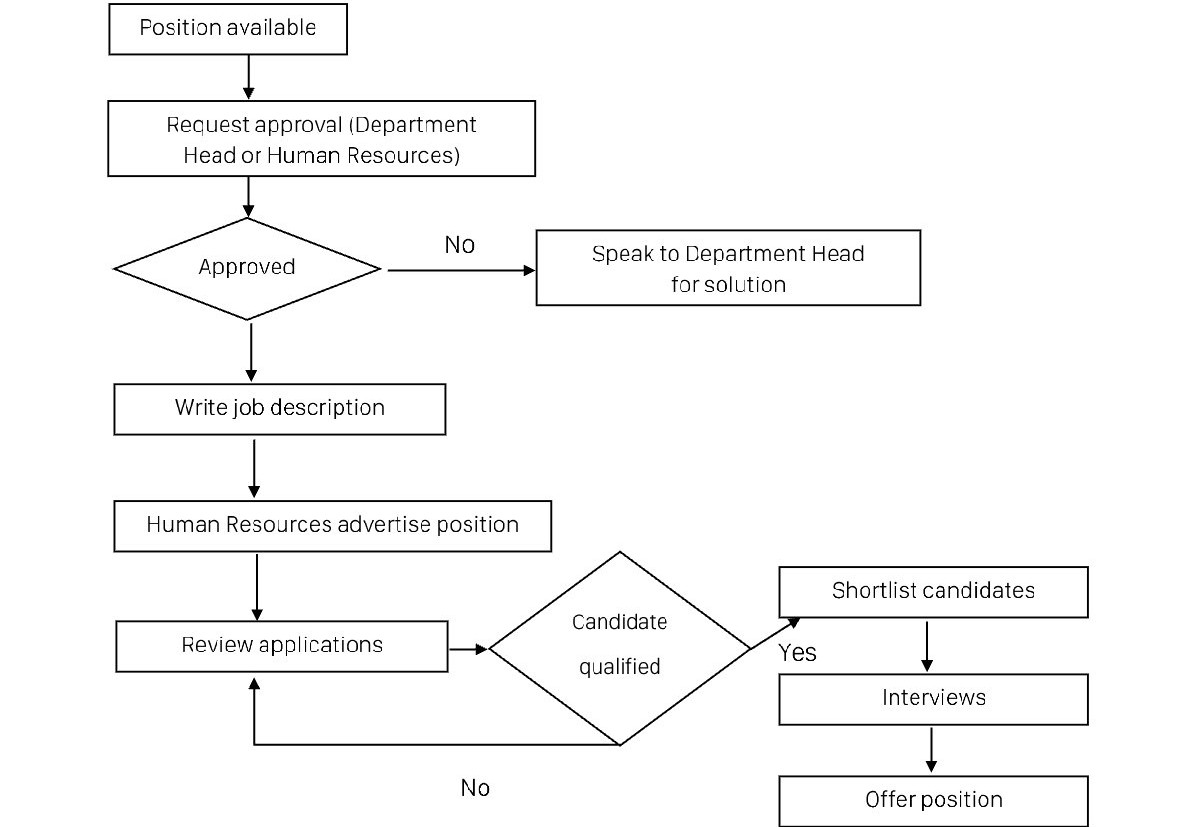
Answer:
The diagram illustrates the process of staff recruitment, showing the various stages involved in hiring a new employee, from identifying an available position to offering the job to a successful candidate.
Overall, the recruitment procedure consists of several stages, beginning with the availability of a position and ending with a job offer. It is a mainly linear process, although there is a possibility of returning to the application review stage if candidates are not considered qualified.
To begin with, when a position becomes available, approval must be requested from either the Department Head or the Human Resources department. If the request is rejected, the relevant person needs to speak to the Department Head to find a suitable solution. However, if approval is granted, the next step is to prepare a job description. Following this, the Human Resources department advertises the vacancy to attract potential applicants.
Subsequently, all applications are reviewed to determine whether candidates meet the required qualifications. If an applicant is not considered suitable, the process returns to the application review stage. In contrast, qualified candidates are shortlisted and invited to attend interviews. After the interviews have been conducted, the final stage involves offering the position to the selected candidate.

Mistakes to Avoid in IELTS Process Diagrams
- Leaving out the overview. This is the most expensive mistake. Even a strong body paragraph can’t make up for it.
- Copying the question word for word. Examiners ignore copied phrases when judging your language, so always paraphrase.
- Describing the diagram like a graph. Words like increase, decrease, trend and fluctuate belong to data charts. Process writing is about stages and sequence.
- Repeating the same linkers. Using “then” and “after that” five times pulls down your Coherence and Cohesion score. Rotate through a range of connectors.
- Getting the passive wrong or missing a stage. Errors like the sand is wash happen under pressure, and skipping a step or changing the order loses marks too. Lightly number each stage on the question paper before you start writing.
- Adding personal ideas. A sentence like this is very useful for the environment has no place in Task 1. Describe only what the diagram shows.
Understanding the sequence of stages and avoiding common mistakes can help you improve your Task 1 performance. To keep improving, practice IELTS Writing Task 1 questions on Gurully, where you can also attempt full-length mock tests with accurate scoring and use section-wise performance analysis to identify areas for improvement. Consistent practice and feedback can bring you closer to your target band score.
FAQ:
What is a process diagram in IELTS Writing Task 1?
How do I structure an IELTS process diagram answer?
Do I need an overview for an IELTS process diagram?
Should I use the passive voice in an IELTS process diagram?
How do I describe a process diagram when I don’t know the technical words?
What is the difference between a natural and a man-made process in IELTS Task 1?
Also Read
IELTS Writing Task 1 Pie Chart
IELTS Writing Task 1 Line Graph
Do Free IELTS Writing Practice