



Why Choose PTE for Canada?
Below are the reasons for choosing PTE.
PTE
AI-Scored Mock Tests To Study And Settle Abroad.IELTS
Computer-Delivered Scored Mock Tests To Study And Settle Abroad.DUOLINGO
Score high on the most convenient English Proficiency test in the world.CELPIP
Best Platform To Meet Canadian Immigration Requirements.Planning to move to Canada for study, work, or permanent residency (PR)? PTE can be an important part of your journey, depending on your application and chosen pathway. Explore everything you need to know about PTE for Canada, including the right test, score requirements, visa and PR pathways, preparation, and other essential information to help you plan your next step with confidence.
Below are the reasons for choosing PTE.

PTE Academic is accepted by Canadian universities and colleges, making it an option for students planning to pursue higher education in Canada.
PTE Core is recognized by IRCC for eligible Canadian economic immigration pathways, including permanent residency and citizenship applications.
Canada PTE offers quick score reporting, with results typically available within 48 hours. This can help you move forward with your study or immigration plans sooner.
PTE is conducted on a computer and assesses the four key English skills Speaking, Writing, Reading, and Listening in a single test session.
PTE offers regular test dates and availability at test centers, giving candidates more flexibility when planning their exam around application deadlines and preparation schedules.
Understand the process of studying in Canada.
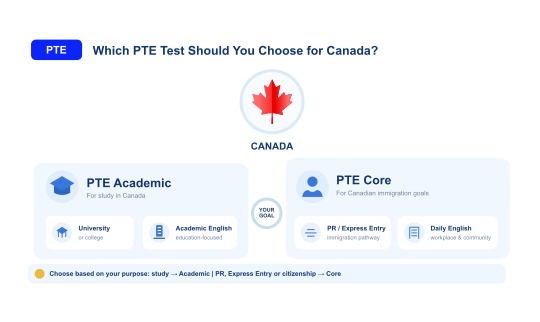
If your goal is to study in Canada, PTE Academic is the relevant PTE test. PTE Core is designed for Canadian immigration and citizenship purposes, not academic admission.
Before booking your test, check whether your chosen Canadian institution and program accept PTE Academic and what score they require. Requirements can vary by institution and program.
Understand the score requirement of Pearson Test of English Canada for your chosen course and prepare accordingly. Focus on all four skills- Speaking, Writing, Reading, and Listening - to achieve the required result.
Book your test, complete the exam, and receive your PTE score. If your score does not meet your institution's requirement, you can plan further preparation and retake the test.
Submit your Canada PTE score along with your academic documents and other required information as part of your admission application. If accepted, you will receive a Letter of Acceptance.
After receiving your acceptance, you can proceed with the study permit process and provide the documents required by the Canadian government.
Choose the Right PTE Test: Select PTE Academic if you are applying to study in Canada, or PTE Core if you are taking the test for eligible Canadian immigration or citizenship purposes.
Visit the official PTE website and check available test centers, dates, and timings that suit your preparation and application timeline.
Sign up for a myPTE account using your personal details. Make sure your name and other information match your identification document exactly.
Choose your preferred test center, date, and time, then review all your appointment details carefully before proceeding.
Pay the applicable test fee using the available payment method for your location. Once the payment is confirmed, your test appointment will be booked.
You will receive a booking confirmation with your test details. You can also view your appointment through your myPTE account.
To book your test, fill in the registration form with your personal details.
Knowing the key steps and requirements can help you plan better.
Start by checking which permanent residence pathway you may qualify for, such as Express Entry or a Provincial Nominee Program (PNP). Express Entry manages applications under three programs: Canadian Experience Class, Federal Skilled Worker Program, and Federal Skilled Trades Program.
If your chosen program requires a language test, take an approved language proficiency test like PTE for Canada PR or a French language test and meet the required language level.
If eligible for Express Entry, create your profile and enter your information about education, work experience, language ability, and other factors. Eligible candidates are placed into the Express Entry pool.
Candidates may receive an Invitation to Apply (ITA) through an Express Entry invitation round. If you receive an ITA, you can proceed with your permanent residence application.
Complete the application, upload the required documents, pay the applicable fees and submit it within the specified deadline. An Express Entry ITA is valid for 60 days.
Explore how Gurully streamlines your PTE Academic preparation.
Select a Canadian institution that is a Designated Learning Institution (DLI) and apply for your chosen program.
After admission, you’ll need a Letter of Acceptance (LOA) from the DLI for your study permit application.
Gather the documents required for your situation, which may include your LOA, passport and proof of financial support.
Generally, you must apply for a study permit before coming to Canada. Submit your application according to IRCC requirements.
Provide biometrics or other documents if requested and wait for the IRCC decision on your application.
Understanding the immigration process can help you choose the right pathway and prepare for the requirements ahead.
Canada offers several permanent immigration pathways, including Express Entry, Provincial Nominee Programs, regional programs and family sponsorship.
Each program has its own requirements. Your eligibility may depend on factors such as education, work experience, language ability, family situation and other program-specific criteria.
Depending on your pathway, you may create an Express Entry profile, apply for a provincial nomination, or submit an application through another eligible immigration program.
Once you are eligible to apply, prepare the required forms, supporting documents, fees and submit your application through the appropriate process.
Depending on the program, you may need to complete biometrics, medical examinations and background checks before IRCC makes a final decision.
Important: Canada does not have one universal "immigration visa." The process depends on why you want to come to Canada and which immigration program you qualify for. H2: Canada Student Visa / Study Permit
Here’s what you need to know about getting Canada PR through the Express Entry system.
Express Entry manages three programs — Canadian Experience Class (CEC), Federal Skilled Worker Program (FSWP), and Federal Skilled Trades Program (FSTP). Check which program you may qualify for based on factors such as work experience, education and language ability.
Complete an approved English or French language test and obtain the required results for your Express Entry program. If you're considering PTE accepted in Canada, make sure you choose the test approved for your specific immigration pathway. Your language results can also contribute to your CRS score.
Submit your online profile to the Express Entry pool. If you’re eligible, IRCC will give you a Comprehensive Ranking System (CRS) score and rank your profile against other candidates.
IRCC conducts invitation rounds and invites eligible candidates with the required ranking to apply for permanent residence. Being in the Express Entry pool does not guarantee an invitation.
After receiving an Invitation to Apply (ITA), you have 60 days to complete and submit your permanent residence application, upload the required documents, pay the applicable fees and complete the required steps, including biometrics when requested.
The cost of living in Canada depends on your city, accommodation, and lifestyle. International students should budget for housing, food, transportation, phone, internet, health insurance, and other daily expenses.
Housing can cost around CAD 500–2,000 per month, depending on the city and whether you choose shared housing, private accommodation, or student residence. Sharing accommodation can help reduce monthly expenses.
Students should budget approximately CAD 240–480 per month for food and groceries. Cooking at home can help keep costs manageable.
Public transportation can cost approximately CAD 80–156 per month, although costs vary by city and student discounts may be available.
Utilities can start from around CAD 100 per month, while internet and phone expenses vary depending on the provider and plan.
EduCanada recommends budgeting at least CAD 23,000 per year for living costs for an international student in 2026, excluding tuition fees. Your actual expenses may be higher or lower depending on your location and lifestyle.
Note: Living costs can vary significantly between Canadian cities. Compare accommodation, transportation, food, and other expenses when planning your study budget.
Learn how to build the right preparation strategy.
Check the PTE Academic score requirement for your university and course. Set your preparation target based on the required score rather than preparing without a specific goal.
Learn the current test format, question types, scoring criteria, and time limits. Knowing what to expect helps you plan your preparation more effectively.
Take an initial mock test to understand your current level. Identify whether you need more work on speaking, writing, reading, or listening, and focus your practice accordingly.
Regular practice is important, but simply taking mock tests is not enough. Work on individual question types, improve your English skills, review your mistakes, and use feedback to improve your performance.
Take regular mock tests as you get closer to your exam. Compare your scores over time, identify recurring mistakes, and continue working on areas that are preventing you from reaching your target score.
Discover how Gurully will support your PTE preparation.
Practice with exam-like PTE mock tests to build confidence and manage time effectively.
Access extensive practice across Speaking, Writing, Reading, and Listening.
Get instant AI evaluation for your Speaking and Writing responses.
Identify your strengths, weaknesses, and areas that need improvement.
Experience a test environment designed to help you prepare for the actual PTE exam.
Practice with regularly updated questions based on recent exam trends.
Learn from sample responses and improve your approach to different question types.
Yes. PTE Core is accepted for Canadian permanent residence (PR) under eligible immigration programs, including Express Entry. Your required score depends on the specific immigration program and the Canadian Language Benchmark (CLB) level you need.
There is no single PTE score requirement for Canada PR. The required PTE Core scores depend on your immigration program and the CLB level required for each skill. For example, the Federal Skilled Worker Program requires at least CLB 7 in all four abilities for the first official language.
For Canada PR and economic immigration, you need PTE Core, not PTE Academic. PTE Core is the Pearson test accepted by IRCC for eligible Canadian immigration pathways, including Express Entry.
Yes, but the test you need depends on your institution and study requirements. PTE Academic is commonly used for admission to Canadian educational institutions, while PTE Core is designed for Canadian immigration purposes. Always check the language requirements of your chosen institution before booking your test.
Yes. You can practice PTE Core with Gurully mock tests to familiarize yourself with the test format, practice all four skills, and identify areas where you need improvement before your actual exam.
Your PTE Core score is valid for two years from the test date. For immigration applications, your language test results generally need to be less than two years old when you apply.
Practice with 30000+ real exam questions