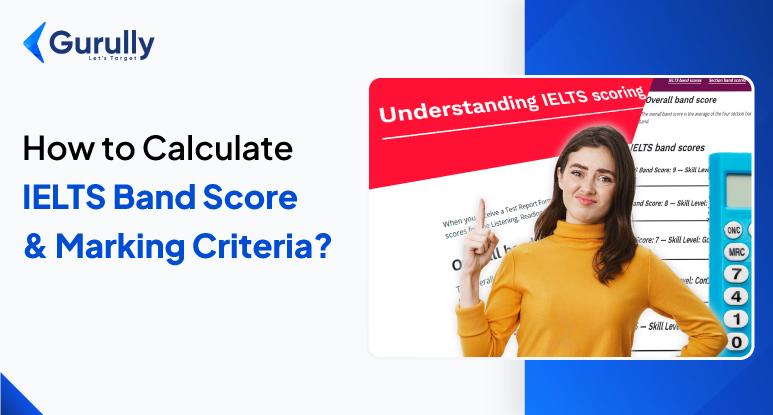
To calculate your overall score in IELTS, add your four section bands (Listening, Reading, Writing, Speaking), divide by four, and round to the nearest half band. According to ielts.org, an average ending in .25 rounds up to the next half band and an average ending in .75 rounds up to the next whole band. So Listening 7, Reading 6.5, Writing 6, Speaking 6.5 gives 26 divided by 4, which is 6.5 overall. This guide shows the rule with worked examples, then explains how each of the four section bands is calculated in the first place.
The IELTS overall band score formula
Overall band = (Listening + Reading + Writing + Speaking) divided by 4, rounded to the nearest half band. Each section is scored from 0 to 9 in half-band steps, so the average can only end in .0, .125, .25, .375, .5, .625, .75 or .875. The rounding rule from ielts.org handles each case:
| Average ends in | Overall band | Why |
| .0 or .5 | Stays as it is | Already a half band |
| .125 | Rounds down to .0 | Nearest half band |
| .25 | Rounds up to .5 | Official rule, .25 goes up |
| .375 | Rounds up to .5 | Nearest half band |
| .625 | Rounds down to .5 | Nearest half band |
| .75 | Rounds up to the next whole band | Official rule, .75 goes up |
| .875 | Rounds up to the next whole band | Nearest half band |
Four worked examples
| Listening | Reading | Writing | Speaking | Total | Average | Overall band |
| 7 | 6.5 | 6 | 6.5 | 26 | 6.5 | 6.5 |
| 6.5 | 6.5 | 6 | 6 | 25 | 6.25 | 6.5 (rounds up) |
| 6 | 6 | 6 | 6.5 | 24.5 | 6.125 | 6.0 (nearest half) |
| 7.5 | 7 | 6.5 | 6.5 | 27.5 | 6.875 | 7.0 (rounds up) |
To check your own combination, enter your four bands in the IELTS score calculator.

How are IELTS band scores calculated for each section?
IELTS band scores are calculated in two different ways. Listening and Reading are marked by counting correct answers out of 40 and converting the raw score to a band. Writing and Speaking are rated by examiners on four criteria each, weighted equally, and the average of the criteria gives the band.
Listening and Reading: raw score to band
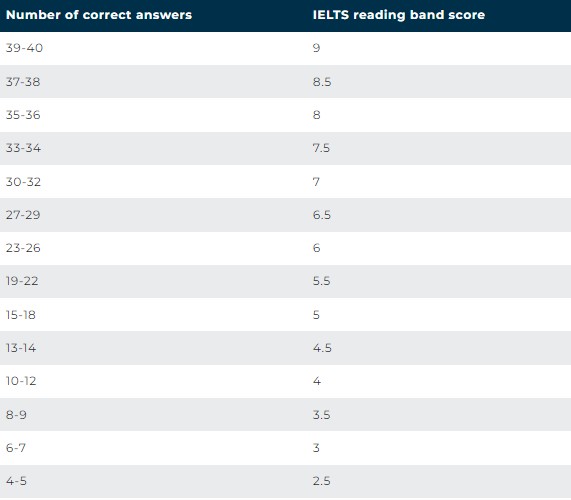
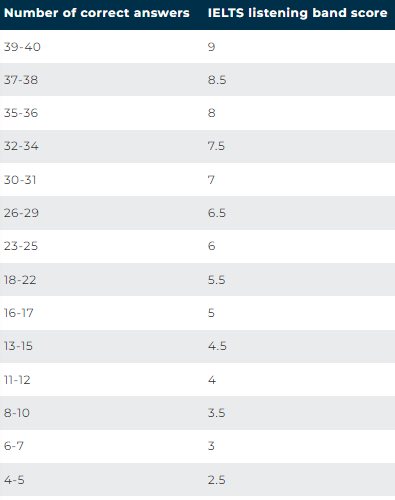
Each test has 40 questions and one mark per correct answer. ielts.org publishes these reference points; the exact marks needed vary slightly between test versions.
| Band
|
Listening (correct out of 40) | Academic Reading (correct out of 40) | General Training Reading (correct out of 40) |
| 8 | 35 | 35 | 38 |
| 7 | 30 | 30 | 35 |
| 6 | 23 | 23 | 30 |
| 5 | 16 | 15 | 23 |
| 4 | not published | not published | 15 |
Academic and General Training Reading are graded on the same scale, but the General Training texts are easier, so more correct answers are needed for the same band.
Writing: four criteria, two tasks
Each task is marked on Task Achievement (Task 1) or Task Response (Task 2), Coherence and Cohesion, Lexical Resource, and Grammatical Range and Accuracy. The four criteria carry equal weight and the task score is their average. Task 2 counts for more than Task 1 in the final Writing band, so a weak essay costs more than a weak report or letter.
Speaking: four criteria, one band
The examiner rates Fluency and Coherence, Lexical Resource, Grammatical Range and Accuracy, and Pronunciation. The four carry equal weight and their average is the Speaking band.
How to raise your overall band by half a band
Because the overall band is an average, the quickest gain usually comes from the weakest section, not the strongest. Three practical moves:
- Find the section furthest below your target and work out how many extra correct answers or which criterion it needs. In Listening and Reading, two or three more correct answers can move a band.
- If your average ends in .125 or .625, you are one half-band in one section away from rounding up. Check which section is closest to the next half band.
- Sit a full-length IELTS mock test with AI scoring to get four section bands at once, then run them through the calculator to see your rounded overall.

Conclusion
Your overall IELTS score is the average of four section bands, rounded to the nearest half band, with .25 and .75 rounding up. Listening and Reading bands come from correct answers out of 40, and Writing and Speaking bands from four equally weighted criteria. Work on the section furthest from your target, and use a full-length IELTS mock test to see all four bands before test day.
FAQ:
How do I calculate my overall IELTS score?
How are IELTS band scores calculated for Listening and Reading?
How are the Writing and Speaking bands calculated?
Does IELTS round 6.25 up or down?
Can my overall band be higher than my best section?
Also Read: