


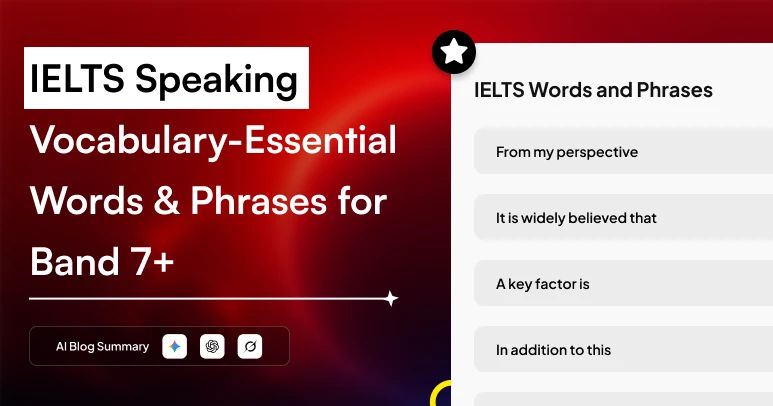
Strong IELTS speaking vocabulary is one of the four things the examiner scores, and it is the easiest one to improve with the right material. This guide gives you that material in one place: ready-to-use phrases for Part 1, Part 2 and Part 3, expressions for opinions, comparisons and trends, plus collocations, idioms and word upgrades that push simple answers towards band 7.
Every entry comes as a phrase with a short example, so you learn words the way you will use them in a spoken sentence. For word lists across all four sections, see vocabulary for IELTS; this page covers the words that come out of your mouth.
What Kind of Vocabulary Do You Need for IELTS Speaking?
The examiner checks your range, accuracy, and how naturally your words fit together. You need five types of vocabulary for the test, and this guide gives a full list for each one below.
Everyday Vocabulary
- Words for daily life: routines, food, weather, transport. Simple words used correctly score better here than rare words used wrongly.
Topic-Specific Vocabulary
- Words for common test themes such as work, education, technology and environment. A few strong phrases per topic beat one long list.
Descriptive Vocabulary
- Words that make people, places and things easy to picture. Part 2 runs on these, because a two-minute talk with only “nice” and “good” runs dry fast.
Opinion Vocabulary
- Ways to give and defend a view. Part 1 needs the casual version, Part 3 needs the formal version, and they are not the same.
Linking and Connecting Expressions
- The glue between ideas: adding, contrasting, giving examples. These help your fluency score as much as your vocabulary score.

IELTS Speaking Vocabulary for Part 1
Part 1 is short questions about you and your life. The right vocab for IELTS speaking here is natural and personal, not academic. Warm up with real questions on the IELTS Speaking Part 1 practice page.
Vocabulary for Talking About Yourself
| Phrase | Example |
|---|---|
| I’m currently | I’m currently in my final year of college. |
| born and raised in | I was born and raised in Surat. |
| a typical day for me | A typical day for me starts at six. |
| I tend to | I tend to sleep early on weekdays. |
| in my free time | In my free time, I watch cricket. |
| I work as | I work as a graphic designer. |
| I live with | I live with my parents and my brother. |
| day to day | Day to day, my routine is quite simple. |
| I’ve been doing X for | I’ve been learning English for two years. |
| as a child | As a child, I loved drawing. |
Vocabulary for Likes and Dislikes
| Phrase | Example |
|---|---|
| I’m really into | I’m really into cooking these days. |
| a big fan of | I’m a big fan of old songs. |
| not really my thing | Shopping is not really my thing. |
| I can’t stand | I can’t stand crowded buses. |
| I’ve grown to like | I’ve grown to like tea. |
| I’m fond of | I’m fond of street food. |
| I really enjoy | I really enjoy long walks. |
| I’m not keen on | I’m not keen on horror films. |
| my favourite | My favourite season is winter. |
| I prefer X to Y | I prefer trains to buses. |
Useful Expressions for Giving Personal Opinions
| Phrase | Example |
|---|---|
| To be honest | To be honest, I prefer quiet weekends. |
| I’d say | I’d say home food is always better. |
| I suppose | I suppose it depends on the weather. |
| If you ask me | If you ask me, mornings are best for study. |
| Personally | Personally, I find trains relaxing. |
| I think | I think small towns are friendlier. |
| In my case | In my case, music helps me focus. |
| I feel | I feel online classes save time. |
| For me | For me, family time matters most. |
| I guess | I guess habits are hard to change. |
IELTS Speaking Vocabulary for Part 2
Part 2 gives you a cue card, one minute to prepare and up to two minutes to speak. Descriptive phrases carry most of the talk, and the same lists work for most cue cards because topics repeat. Try full cue cards on the IELTS Speaking Part 2 practice page.
Vocabulary for Describing People
| Phrase | Example |
|---|---|
| down to earth | She’s very down to earth. |
| easy-going | He’s easy-going and friendly. |
| someone I look up to | My coach is someone I look up to. |
| a great sense of humour | She has a great sense of humour. |
| generous with their time | My teacher was generous with her time. |
| hard-working | My father is very hard-working. |
| supportive | My friends are really supportive. |
| soft-spoken | My grandmother is soft-spoken and kind. |
| full of energy | My nephew is always full of energy. |
| reliable | He’s the most reliable person I know. |
Vocabulary for Describing Places
| Phrase | Example |
|---|---|
| breathtaking scenery | The valley had breathtaking scenery. |
| bustling | The market is bustling every morning. |
| a peaceful atmosphere | The library has a peaceful atmosphere. |
| tucked away | The cafe is tucked away behind the station. |
| well worth a visit | The old fort is well worth a visit. |
| crowded | The beach gets crowded on Sundays. |
| spacious | The new mall is quite spacious. |
| lively | Our street feels lively in the evening. |
| scenic | The drive to the hills is scenic. |
| close to nature | The campsite is close to nature. |
Vocabulary for Describing Experiences
| Phrase | Example |
|---|---|
| a once-in-a-lifetime experience | The trek was a once-in-a-lifetime experience. |
| took me by surprise | The result took me by surprise. |
| I’ll never forget | I’ll never forget my first flight. |
| looking back | Looking back, it changed my thinking. |
| it taught me a lot | Living alone taught me a lot. |
| challenging | The first month was challenging. |
| unforgettable | The whole trip was unforgettable. |
| out of my comfort zone | The job pushed me out of my comfort zone. |
| a proud moment | Graduation was a proud moment for me. |
| worth the effort | The climb was worth the effort. |
Vocabulary for Describing Events
| Phrase | Example |
|---|---|
| a memorable occasion | The wedding was a memorable occasion. |
| the highlight of | The fireworks were the highlight of the night. |
| went off without a hitch | The event went off without a hitch. |
| in high spirits | Everyone was in high spirits. |
| the atmosphere was electric | The atmosphere was electric after the win. |
| well organised | The festival was well organised. |
| a big turnout | There was a big turnout this year. |
| celebrate | We celebrate Diwali with the whole family. |
| get together | The family gets together every New Year. |
| a special day | My sister’s birthday is a special day for us. |
Vocabulary for Describing Objects
| Phrase | Example |
|---|---|
| handy | This tool is really handy. |
| built to last | My father’s watch was built to last. |
| sentimental value | The ring has sentimental value. |
| state of the art | The new lab is state of the art. |
| on a daily basis | I use my phone on a daily basis. |
| lightweight | The laptop is lightweight and fast. |
| durable | These shoes are durable. |
| good value for money | The bike was good value for money. |
| easy to use | The app is easy to use. |
| a gift from | The pen was a gift from my mentor. |
IELTS Speaking Vocabulary for Part 3
Part 3 moves from your life to ideas: society, change, causes and effects. The expressions for IELTS speaking here are more formal than Part 1. Discussion questions are on the IELTS Speaking Part 3 practice page.
Vocabulary for Giving Opinions
| Phrase | Example |
|---|---|
| From my point of view | From my point of view, cities need more parks. |
| It seems to me that | It seems to me that prices rise every year. |
| I’d argue that | I’d argue that skills matter more than degrees. |
| In my opinion | In my opinion, public transport needs work. |
| I strongly believe | I strongly believe education should be free. |
| As I see it | As I see it, both sides have a point. |
| My view is that | My view is that change takes time. |
| To my mind | To my mind, health comes first. |
| It’s clear that | It’s clear that habits are changing. |
| Many people believe, but | Many people believe money buys happiness, but I doubt it. |
Vocabulary for Agreeing and Disagreeing
| Phrase | Example |
|---|---|
| I completely agree | I completely agree with that idea. |
| That’s true up to a point | That’s true up to a point, but cost matters. |
| I see it differently | I see it differently, to be honest. |
| I’m not entirely convinced | I’m not entirely convinced by that. |
| Absolutely | Absolutely, schools should teach life skills. |
| I partly agree | I partly agree, but there are risks. |
| That’s a fair point, but | That’s a fair point, but not everyone can afford it. |
| I couldn’t agree more | I couldn’t agree more with that. |
| I doubt that | I doubt that it works for everyone. |
| It depends | It depends on the situation, really. |
Vocabulary for Explaining Causes
| Phrase | Example |
|---|---|
| mainly due to | This is mainly due to long working hours. |
| one of the main reasons | One of the main reasons is high rent. |
| stems from | The problem stems from poor planning. |
| driven by | The change is driven by social media. |
| because of | Because of traffic, people leave home early. |
| caused by | Stress is often caused by overwork. |
| the root cause | The root cause is a lack of jobs. |
| thanks to | Thanks to the internet, learning is easier. |
| a major factor | Cost is a major factor here. |
| comes down to | It often comes down to money. |
Vocabulary for Explaining Effects
| Phrase | Example |
|---|---|
| as a result | As a result, fewer people cook at home. |
| this leads to | This leads to more stress. |
| the knock-on effect | The knock-on effect is higher prices. |
| in the long run | In the long run, it harms health. |
| because of this | Because of this, cities grow fast. |
| consequently | Consequently, demand keeps rising. |
| this means that | This means that skills matter more now. |
| one effect is | One effect is less family time. |
| it results in | It results in better job chances. |
| over time | Over time, habits slowly change. |
Vocabulary for Comparing Ideas
| Phrase | Example |
|---|---|
| compared with | Compared with the past, we travel more. |
| unlike in the past | Unlike in the past, people change jobs often. |
| a world of difference | There’s a world of difference between the two. |
| in some ways, in other ways | In some ways easier, in other ways harder. |
| similar to | Town life is similar to city life in some ways. |
| far more X than | Online shopping is far more common than before. |
| while | While cities offer jobs, villages offer peace. |
| both, but | Both are useful, but one is cheaper. |
| the main difference | The main difference is the pace of life. |
| not as X as | Buses are not as fast as the metro. |
Vocabulary for Talking About Trends
| Phrase | Example |
|---|---|
| a growing tendency | There’s a growing tendency to shop online. |
| more and more people | More and more people work from home. |
| increasingly common | Cashless payment is increasingly common. |
| a noticeable shift | There’s a noticeable shift towards healthy food. |
| on the rise | Online learning is on the rise. |
| becoming popular | Electric cars are becoming popular. |
| these days | These days, everyone orders food online. |
| a recent trend | A recent trend is short video content. |
| slowly disappearing | Letter writing is slowly disappearing. |
| here to stay | Remote work is here to stay. |
IELTS Speaking Vocabulary for Different Functions
These phrases for IELTS speaking work in every part of the test. Use them to give examples, add points, show contrast, guess about things and talk about the future.
Vocabulary for Giving Examples
| Phrase | Example |
|---|---|
| for instance | Public transport, for instance, has improved. |
| take, for example | Take my city, for example. |
| a good example is | A good example is food delivery apps. |
| such as | Skills such as coding are in demand. |
| like | Small things, like a walk, reduce stress. |
| to give you an idea | To give you an idea, my commute is two hours. |
| one example is | One example is online banking. |
| especially | Prices rise, especially during festivals. |
| in particular | Young people, in particular, prefer apps. |
| as an example | As an example, my school went fully digital. |
Vocabulary for Adding Ideas
| Phrase | Example |
|---|---|
| on top of that | On top of that, it saves time. |
| what’s more | What’s more, it’s cheaper. |
| not to mention | It’s fast, not to mention easy. |
| another thing is | Another thing is the cost. |
| also | It also helps the environment. |
| as well as | It saves money as well as time. |
| besides that | Besides that, it’s safer. |
| plus | Plus, you can do it from home. |
| along with | Along with that, service has improved. |
| another point is | Another point is convenience. |

Vocabulary for Showing Contrast
| Phrase | Example |
|---|---|
| on the other hand | On the other hand, it reduces contact. |
| having said that | Having said that, some prefer cash. |
| whereas | I like tea, whereas my brother likes coffee. |
| even so | Even so, many people still travel daily. |
| but | It’s useful, but it’s costly. |
| however | However, not everyone agrees. |
| although | Although it’s fast, it’s expensive. |
| despite that | Despite that, sales keep growing. |
| still | Still, some things never change. |
| on the contrary | On the contrary, it saves money. |
Vocabulary for Speculating
| Phrase | Example |
|---|---|
| it might be that | It might be that people have less time. |
| I imagine | I imagine offices will stay hybrid. |
| it could well be | It could well be a passing trend. |
| perhaps | Perhaps prices will drop soon. |
| maybe | Maybe habits will change slowly. |
| possibly | It could possibly get worse. |
| I’m not sure, but | I’m not sure, but it seems likely. |
| it’s hard to say | It’s hard to say what comes next. |
| my guess is | My guess is more people will move online. |
| there’s a chance | There’s a chance things improve next year. |
Vocabulary for Talking About the Future
| Phrase | Example |
|---|---|
| in the years to come | In the years to come, cities will get greener. |
| I expect | I expect fewer petrol cars on the road. |
| sooner or later | Sooner or later, everything will be digital. |
| in the near future | In the near future, AI will be everywhere. |
| going forward | Going forward, skills will matter most. |
| one day | One day, travel may be much cheaper. |
| in future | In future, people may work less. |
| it’s likely that | It’s likely that this will continue. |
| will probably | Cities will probably keep growing. |
| I can see X happening | I can see remote work becoming normal. |
Useful Collocations for IELTS Speaking
Collocations are word pairs that native speakers use together. Use them correctly and your answers sound natural, which directly improves your vocabulary score.
| Collocation | Example |
|---|---|
| take up a hobby | I took up painting during the holidays. |
| strike up a conversation | I struck up a conversation with a tourist. |
| catch up with friends | Weekends are for catching up with friends. |
| broaden your horizons | Travel really broadens your horizons. |
| make a living | It’s hard to make a living from art alone. |
| play a part in | Luck plays a part in every success. |
| heavy traffic | Heavy traffic makes my commute long. |
| meet a deadline | I stayed up late to meet a deadline. |
| pay attention | I pay attention to small details. |
| spend quality time | I spend quality time with family on Sundays. |
Basic Words vs Better IELTS Speaking Vocabulary
Advanced vocabulary for IELTS speaking is about precision, not rare words. Each better choice below is a word people use in real talk, which is exactly why it works.
| Basic word | Better choice | Example |
|---|---|---|
| good | rewarding | Teaching is a rewarding job. |
| bad | frustrating | The delays were really frustrating. |
| big | enormous | The stadium was enormous. |
| happy | thrilled | I was thrilled with my result. |
| sad | disheartening | The news was disheartening. |
| nice | welcoming | The staff were very welcoming. |
| very tired | exhausted | I was exhausted after the trek. |
| very interesting | fascinating | The museum was fascinating. |
| very busy | hectic | My schedule is hectic this month. |
| very old | ancient | The temple is ancient. |
IELTS Speaking Idioms and Phrases
Idioms count as natural language at band 7, but only in small amounts. This table gives ten safe, common idioms with their meaning and a spoken example. Use one or two per test, and only where they fit the topic.
| Idiom | Meaning | Example |
|---|---|---|
| over the moon | extremely happy | I was over the moon when I got the offer. |
| once in a blue moon | very rarely | I eat out once in a blue moon. |
| a piece of cake | very easy | The first section was a piece of cake. |
| cost an arm and a leg | very expensive | Flights cost an arm and a leg in December. |
| get the hang of it | learn how to do it | Driving took time, but I got the hang of it. |
| break the ice | ease early awkwardness | A small joke helped break the ice. |
| run out of steam | lose energy | By evening, I usually run out of steam. |
| off the beaten track | away from tourist spots | We found a beach off the beaten track. |
| hit the books | study hard | I need to hit the books before exams. |
| kill two birds with one stone | do two things at once | Cycling to work kills two birds with one stone. |
Mistakes To Avoid
- Memorising full answers: Examiners spot scripts, and a rehearsed answer costs more than the vocabulary gains.
- Forcing idioms into every answer: One natural idiom helps your score; too many make your answer sound memorised.
- Choosing rare words over right words: A big word used wrongly loses marks a simple word would have kept.
- Using one linking word again and again: Repeating “basically” or “actually” in every sentence counts against your range.
- Learning silently: Words you have only read are hard to recall while speaking. Say every new phrase aloud.
- Translating from your first language: That is where errors like “do a mistake” come from.
Practice Tips To Use Vocabulary Naturally
- Learn phrases, not single words: A phrase carries its own grammar, so it comes out ready-made.
- Say each new phrase aloud ten times: On the day you learn it, then again the next day.
- Record one answer a day and play it back: A pause before a phrase means it is not ready yet.
- Work one topic at a time: Ten solid phrases on work beat a hundred scattered words.
- Drop what you stumble on twice: A phrase that trips you is costing fluency marks.
- Practise with something that scores you: Because repeating errors with no feedback locks them in.
Building this vocabulary is half the work; testing it under exam pressure is the other half. Gurully offers IELTS speaking practice question by question, and a free IELTS mock test that runs the full speaking test in real exam conditions. With accurate instant AI scoring and detailed performance analysis, you can identify your strengths, work on weaker areas, and build the confidence needed to achieve your target band score.
FAQ:
What vocabulary do I need for a band 7 in IELTS Speaking?
Can I use idioms in IELTS Speaking?
How many words should I learn for IELTS Speaking?
Do memorised phrases lower my IELTS Speaking score?
Does grammar matter more than vocabulary in IELTS Speaking?
How can I improve my vocabulary for IELTS speaking?
Also Read:
Practice Popular IELTS Speaking Questions