


While preparing for the IELTS exam, students often get confused about the target score they want to aim for. Scoring in IELTS is divided into 4 sections: Reading, Writing, Listening & Speaking. And by combining individual scores, a final band is given. If your exam is coming and you are wondering what band you need, then here is the complete information on the IELTS score chart.
After going through this IELTS band score chart, you can decide your target score and attempt IELTS exam online test. It will help you know your preparation level.
How the IELTS Score Chart Works?
IELTS follows a 9-band scale, rather than percentages or grades. Each band represents a level of ability in English. You are assessed in four parts:
Check Your IELTS Preparation Level
Each of these sections is scored separately. After that, all four scores are averaged to give you your overall band. To make it clearer, here’s a simple example:
Section Band Score
- Listening: 7
- Reading: 6.5
- Writing: 6
- Speaking: 7
Overall Band – 6.5
The final score isn’t always a straight average – it gets rounded. For example, if your average comes out to 6.25, it moves up to 6.5. If it’s 6.75, it becomes 7. That small rounding step can actually change your final result quite a bit.

IELTS Band Score Chart
| Band Score | Proficiency Level |
| 9 | Expert |
| 8 | Very Good |
| 7 | Good |
| 6 | Competent |
| 5 | Modest |
| 4 | Limited |
| 3 | Extremely Limited |
| 2 | Intermittent |
| 1 | Non-user |
| 0 | Did not attempt the test |
These labels are useful, but they don’t always explain what the score feels like in real situations. That’s where a deeper look helps.
Source- Click Here
Explanation of PTE Score Chart in Detail
Band 9
At this level, using English feels almost automatic. You don’t need to pause to think about grammar or vocabulary. Whether in a formal or casual discussion, the candidate is fluent in both.
Band 8
If you have achieved this band, it shows that your English proficiency is very comfortable. You might make mistakes, but very minor and do not affect the communication. You can handle academic work or professional settings without much difficulty.

Band 7
This is a strong level, and it means you are capable of expressing ideas clearly even if the topic is complex. Although you might make noticeable mistakes, especially with unfamiliar subjects.
Band 6
This level of English proficiency lets you communicate effectively in everyday situations. But the control on the English is not consistent, and you make mistakes in grammar and word choice.
Band 5
You are able to manage communication only up to a certain point. If the situation is demanding you might not be able to express yourself clearly.
Band 4
Your English language proficiency is quite limited. Understanding simple ideas is manageable, but a proper response to the conversation becomes difficult.
Bands 3
You can convey and understand only the general meaning. In an unfamiliar situation, you are not able to communicate as per the requirement.
Band 0 to 1
You are not able to understand the English language. Communication is either broken or extremely basic, often limited to isolated words or short phrases.
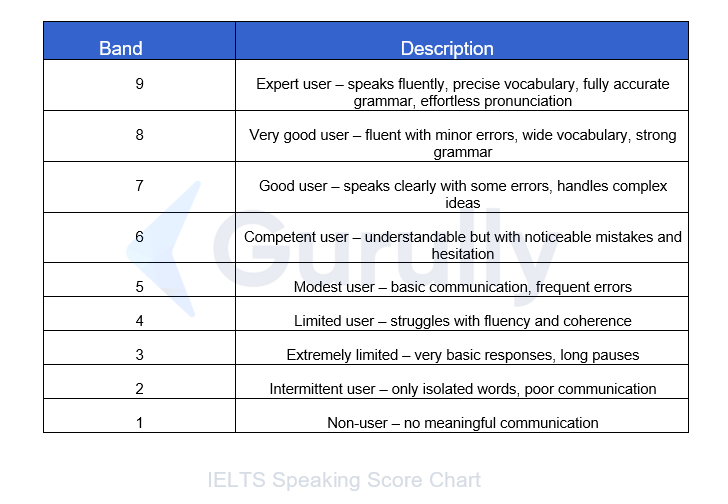
IELTS Speaking Score Chart
In the speaking section of IELTS, scoring is done on 4 criteria: Fluency and coherence, Lexical Resources, Grammar
IELTS Reading Score Chart
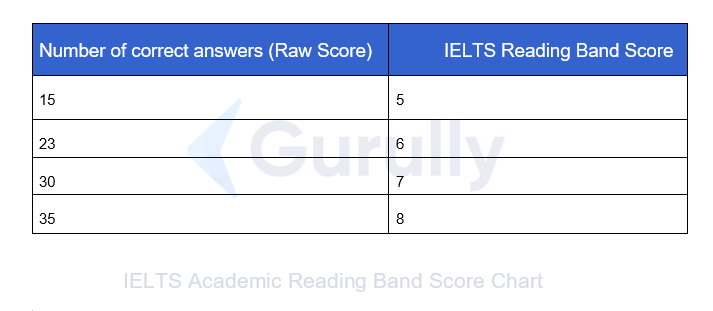
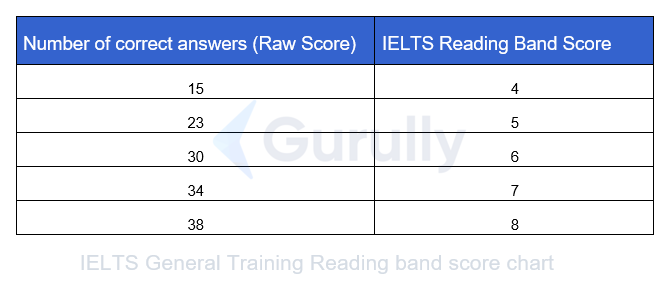
The IELTS reading score is generally evaluated based on the range of questions attempted correctly. In total, there are 40 questions.
IELTS Academic Reading Band Score Chart
 IELTS General Training Reading Band Score Chart
 For more check here.
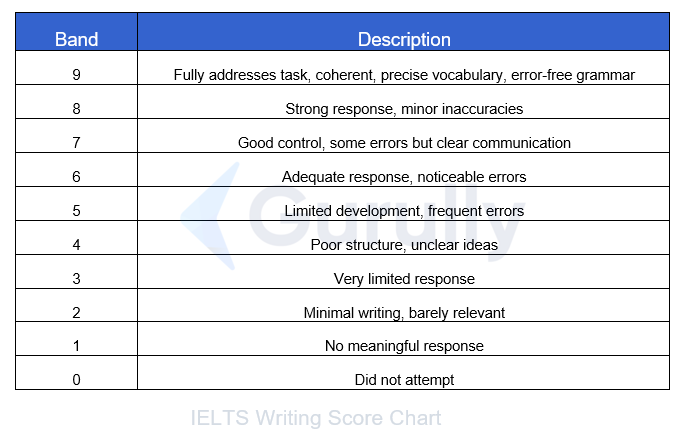
IELTS Writing Score Chart
In the writing section of IELTS, scoring is done on 4 criteria – Coherence & Cohesion, Lexical Resource, Grammar, Task Achievement/Response
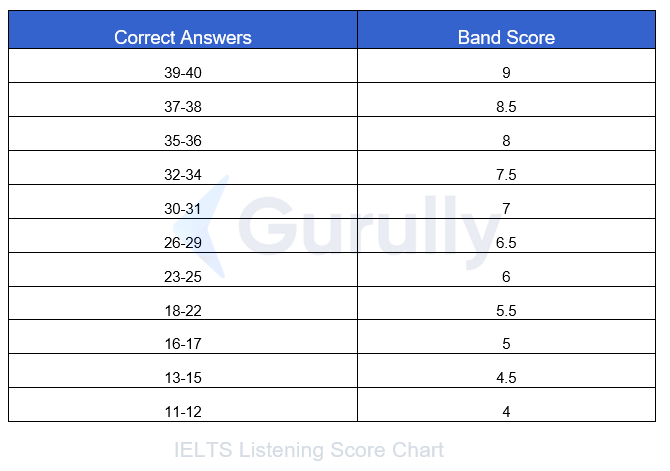
IELTS Listening Score Chart
The IELTS listening score is generally evaluated based on the range of questions attempted correctly. In total, there are 40 questions.
Common Misunderstandings About IELTS Scores
- A lot of students assume IELTS is a pass-or-fail exam. It isn’t. There’s no fixed “passing score.” Your band simply shows your level of English.
- Another common assumption is that a high score in one section can balance out a low score in another. In reality, since all four sections are equally weighted, one weak area can pull down your overall band.
- Half bands are also often underestimated. Moving from 6.5 to 7 may seem small, but it can make a difference when applying to universities or for visas.
Looking at Your Score More Practically
Instead of focusing only on the number, it helps to think of your score in terms of ability:
- Band 5–6: You can manage everyday communication, but with effort
- Band 6–7: You are fairly comfortable, though not fully confident
- Band 7–8: You can handle most situations without difficulty
- Band 8–9: Your English is very strong and close to fluent
When you look at it this way, your score becomes more meaningful. It stops being just a number and starts reflecting what you can actually do with the language.
You can practice on Gurully for scoring high in CD IELTS. Our online practice platform offers full-length mock tests designed to closely replicate the real exam environment, helping students build confidence and reduce exam-day anxiety. Each test is structured to mirror the actual format, timing, and difficulty level, giving a truly realistic practice experience. With AI-powered scoring, students receive accurate and instant results, along with meaningful insights into their performance.
FAQs
Is 7 a good score for IELTS?
Is 8.0 a high IELTS score?
Is IELTS hard to pass?
Is 6.75 converted to 7 in IELTS?
Is 6.0 a pass in IELTS?
Also Read:
- Set Your Target Score – Know Scoring Pattern Of DUOLINGO Vs IELTS
- PTE vs CELPIP vs IELTS: Which Is Best English Test For Canada PR
- IELTS Speaking Tips for Band 7- Practice & Achieve Your Target Score