
IELTS Reading can feel like a race against the clock. You get three passages, 40 questions, and 60 minutes to answer them all. Most students don’t run out of English. They run out of time, or they lose points on questions they understood but answered carelessly. Note completion is a good example. The task looks simple, yet many students lose marks by going over the word limit, misspelling a word, or copying the answer from the wrong sentence.
The good news is that note completion follows clear rules, and a few smart habits can turn it into one of the easiest question types in the test. In this blog, you will learn what IELTS Reading note completion is, how to solve it step by step, expert tips, common mistakes, and five practice sets with answers.
What Is Note Completion in IELTS Reading?
In IELTS Reading note completion, you get a set of notes that summarize part of the passage. Some words are missing, and you fill each gap using words taken from the text. In another version of the task, you choose the missing words from a list of options instead.
Here is what you need to know before you start.
- Word limit. The instructions always tell you how many words you can write, such as ONE WORD ONLY or NO MORE THAN TWO WORDS AND/OR A NUMBER. If you write more than the limit, you lose the mark.
- Answer location. According to ielts.org, the answers may not come in the same order as the text, but they usually come from one part of the passage rather than the whole text.
- Hyphenated words. A hyphenated word such as “check-in” or “problem-solving” counts as one word.
- Exact words. You copy the words as they appear in the passage. You don’t change their form or use a synonym.
Note completion is a close cousin of summary, table, and flow chart completion, so the same skills will help you across several IELTS Reading question types, including multiple choice questions.

How to Solve IELTS Reading Note Completion Questions Step by Step
Step 1. Read the Instructions and Circle the Word Limit
Before you look at the passage, check how many words you can write. This one detail decides whether a correct answer gets a mark or not.
Step 2. Use the Title and Headings of the Notes
Note sets usually have a title and small headings, such as “Advantages” or “Threats.” These headings work like a map. They tell you which paragraph of the passage each group of questions comes from.
Step 3. Predict the Type of Missing Word
Read the words before and after each gap. Ask yourself whether the gap needs a noun, a verb, an adjective, or a number. A gap after “the” or “a” usually needs a noun, and a gap after “more” or “very” usually needs an adjective. Also check whether a noun should be singular or plural.
Step 4. Scan for Keywords and Paraphrases
Pick the keywords around the gap, such as names, dates, numbers, and technical terms, and scan the passage for them. Remember that the passage often uses different words for the same idea, so look for synonyms as well as exact matches.
Step 5. Read the Full Sentence and Copy the Answer
Once you find the right part of the text, read the whole sentence carefully. Copy the missing word or words exactly as they appear in the passage.
Step 6. Check Grammar, Spelling, and the Word Limit
Read the completed note again. The answer should fit the grammar of the sentence, be spelled correctly, and stay within the word limit.
Tips For IELTS Reading Note Completion
Read the Questions First
- Before you read a passage in detail, look at its notes. Underline the keywords in each line, such as names, dates, numbers, technical terms, and unusual words.
- These keywords are your anchors. When you return to the passage, you’ll know exactly what you’re looking for, and you won’t waste time reading sentences that don’t help.
Skim, Then Scan
- Skimming and scanning are different skills, and good readers use both.
- Skimming means reading quickly to get the main idea of each paragraph. Read the first and last sentences of each paragraph, and notice the topic words. This helps you match each heading in the notes to the right paragraph.
- Scanning means moving your eyes quickly over the text to locate a specific keyword, number, or name. Once you’ve matched a keyword from the notes to the passage, read that section carefully.
- Don’t read every line word by word. That habit eats up your time and rarely improves accuracy.
Learn to Spot Paraphrasing
- The note is almost never written in the same words as the passage. The passage will say the same thing in different language.
- If a note says “a decline in population,” the passage might say “fewer residents were living in the area.”
- Train yourself to look for synonyms, reversed sentence structures, and general-to-specific shifts. Building a list of common paraphrases as you practice will make scanning much faster.
Use Grammar to Check Your Answer
- Every answer must fit the sentence grammatically. If the note says “helped finance public libraries” after the gap, your answer must work as the subject of that sentence.
- Watch for articles and plurals. If the gap comes after “a,” the answer is a singular noun, and if the sentence uses “are,” the answer is likely plural.
Manage Your Time with Discipline
- Expect about 20 minutes per passage, and keep an eye on the clock. Passages usually get harder as you move through the test.
- If you’re stuck on a gap for more than a minute or two, make a guess, mark it, and move on. Every question is worth the same mark.
- Practice under timed conditions. Accuracy comes more easily when you’re comfortable with the pace.

Practice Questions For IELTS Reading Note Completion
Try the five practice sets below under timed conditions. Read the instructions carefully, as the word limit changes between sets. For more passages, use Gurully’s IELTS Reading practice questions.
Sample Question 1
Reading Passage: The Development of Public Libraries
Public libraries have played an important role in providing access to information and education for centuries. In the past, books were often expensive, which meant that only wealthy individuals could afford to build personal collections. The establishment of public libraries helped make reading materials available to a much wider section of society.
During the nineteenth century, public libraries expanded significantly in many industrial cities. Local governments and charitable organisations provided funding to establish libraries where people could read books and newspapers without having to purchase them. Some libraries also introduced reading rooms, giving visitors a quiet place to study.
As technology developed, libraries began offering more than printed materials. In the late twentieth century, many libraries introduced computers and internet access. These services became particularly valuable for people who did not have computers at home. Today, libraries may provide digital books, online learning resources and workshops that help visitors develop practical skills.
Despite these changes, the primary purpose of public libraries remains the same. Libraries exist to provide accessible information and support lifelong learning. Many libraries also organise community events, children’s reading programmes and educational activities for people of different ages.
Questions 1–6
Complete the notes below. Choose NO MORE THAN TWO WORDS from the passage for each answer.
Notes on the Development of Public Libraries
Early Development
- In the past, books were expensive, so personal collections were mainly owned by (1) __________.
- Public libraries made reading materials available to a wider section of (2) __________.
Expansion in the Nineteenth Century
- Local governments and (3) __________ helped finance public libraries.
- Reading rooms provided visitors with a quiet place to (4) __________.
Modern Libraries
- During the late twentieth century, libraries began providing computers and (5) __________.
- Today, libraries offer digital books, online learning resources and workshops to develop practical (6) __________.
Answers
1 – Wealthy individuals (Paragraph 1, “only wealthy individuals could afford to build personal collections”)
2 – Society (Paragraph 1, “a much wider section of society”)
3 – Charitable organisations (Paragraph 2, “Local governments and charitable organisations provided funding”)
4 – Study (Paragraph 2, “a quiet place to study”)
5 – Internet access (Paragraph 3, “introduced computers and internet access”)
6 – Skills (Paragraph 3, “workshops that help visitors develop practical skills”)
Sample Question 2
Reading Passage: The Benefits of Urban Green Spaces
Urban green spaces, including public parks, gardens and recreational areas, play an important role in improving the quality of life in cities. As urban populations grow, these spaces provide residents with places to relax, exercise and connect with nature.
One major benefit of green spaces is their positive impact on physical health. People who have access to nearby parks are more likely to participate in activities such as walking, jogging and cycling. Regular physical activity can reduce the risk of certain health problems, including heart disease and obesity.
Green spaces also contribute to better mental health. Spending time in natural environments can help reduce stress and improve mood. Researchers have found that even short visits to parks may help people feel more relaxed, particularly those who experience the pressures of busy urban lifestyles.
In addition to their health benefits, green spaces support the local environment. Trees absorb carbon dioxide and release oxygen, while their shade can help lower temperatures in built-up areas. Plants and trees also provide habitats for birds, insects and other wildlife, helping to maintain biodiversity in cities.
However, maintaining urban green spaces requires careful planning and sufficient funding. Local authorities must ensure that parks remain clean, safe and accessible to everyone. Community involvement can also help protect these areas and encourage residents to take greater responsibility for their surroundings.
Questions 1–6
Complete the notes below. Choose ONE WORD ONLY from the passage for each answer.
Benefits of Urban Green Spaces
Physical Health
- Public parks encourage people to participate in activities such as walking, jogging and (1) __________.
- Regular physical activity can reduce the risk of heart disease and (2) __________.
Mental Health
- Spending time in natural environments can help reduce (3) __________.
- Short visits to parks may help people feel more (4) __________.
Environmental Benefits
- Trees absorb carbon dioxide and release (5) __________.
- Trees and plants provide habitats for wildlife, helping maintain (6) __________ in cities.
Answers
1 – Cycling (Paragraph 2, “walking, jogging and cycling”)
2 – Obesity (Paragraph 2, “including heart disease and obesity”)
3 – Stress (Paragraph 3, “help reduce stress and improve mood”)
4 – Relaxed (Paragraph 3, “help people feel more relaxed”)
5 – Oxygen (Paragraph 4, “absorb carbon dioxide and release oxygen”)
6 – Biodiversity (Paragraph 4, “helping to maintain biodiversity in cities”)

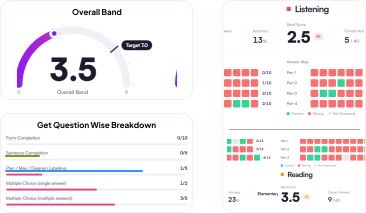
Know Your Strengths. Find Your Gaps. Prepare Smarter.
- Understand Your Performance- Identify strengths and areas that need more attention.
- Track Your Progress – Review your performance across IELTS sections.
- Focus on What Matters- Use your feedback to plan more targeted preparation.
Sample Question 3
Reading Passage: The Importance of Bees in Agriculture
Bees play a crucial role in agriculture by helping plants reproduce through pollination. When bees visit flowers to collect nectar and pollen, they transfer pollen between flowers, allowing many plants to produce fruits and seeds. This natural process is essential for the production of numerous crops consumed by humans.
Agricultural crops such as apples, almonds and strawberries benefit significantly from bee pollination. Without sufficient pollinators, farmers may experience lower crop yields and reduced quality of produce. As a result, bees contribute not only to food production but also to the economic stability of farming communities.
However, bee populations have faced several challenges in recent years. The widespread use of pesticides can harm bees, while the destruction of natural habitats reduces the availability of suitable places for nesting and feeding. Climate change may also affect the availability of flowers and alter the timing of flowering seasons, making it harder for bees to find food.
To protect bee populations, experts recommend planting a variety of flowering plants and reducing the use of harmful chemicals. Farmers can also create suitable habitats by leaving sections of land undisturbed. In urban areas, individuals can support bees by growing flowers in gardens, balconies and public spaces.
Protecting bees requires cooperation between farmers, governments and local communities. By adopting bee-friendly practices, people can help maintain healthy ecosystems and support long-term agricultural productivity.
Questions 1–6
Complete the notes below. Choose NO MORE THAN TWO WORDS from the passage for each answer.
The Role of Bees in Agriculture
Importance of Pollination
- Bees transfer pollen between flowers, helping plants produce fruits and (1) __________.
- Crops such as apples, almonds and (2) __________ benefit from bee pollination.
- A lack of pollinators may lead to lower crop yields and reduced (3) __________ of produce.
Threats to Bee Populations
- The widespread use of (4) __________ can be harmful to bees.
- The destruction of natural habitats reduces suitable places for nesting and (5) __________.
Protecting Bees
- Experts recommend planting a variety of (6) __________ to support bee populations.
Answers
1 – Seeds (Paragraph 1, “produce fruits and seeds”)
2 – Strawberries (Paragraph 2, “apples, almonds and strawberries”)
3 – Quality (Paragraph 2, “reduced quality of produce”)
4 – Pesticides (Paragraph 3, “The widespread use of pesticides can harm bees”)
5 – Feeding (Paragraph 3, “suitable places for nesting and feeding”)
6 – Flowering plants (Paragraph 4, “planting a variety of flowering plants”)
Sample Question 4
Reading Passage: The Growth of Online Education
Online education has become increasingly popular due to improvements in technology and the widespread availability of the internet. Students can now access educational materials from their homes without needing to travel to a school or university. This flexibility has made online learning particularly attractive to working professionals and people living in remote areas.
One of the main advantages of online education is that students can study at their own pace. Many online courses provide recorded lectures, allowing learners to review difficult topics whenever necessary. In addition, digital learning platforms often include quizzes and assignments that help students evaluate their progress and identify areas for improvement.
Despite these benefits, online education also presents certain challenges. Students may find it difficult to remain motivated without direct supervision from teachers. Technical problems, such as an unreliable internet connection, can also interrupt learning. Furthermore, online courses may offer fewer opportunities for face-to-face interaction, which can affect communication and collaboration among students.
To improve the online learning experience, educational institutions are introducing interactive tools, live classes and discussion forums. These features allow students to communicate with teachers and classmates more easily. Some institutions also provide regular feedback to help learners understand their mistakes and improve their performance.
As technology continues to develop, online education is expected to play an increasingly important role in education. However, its success depends on providing accessible resources, effective teaching methods and sufficient support for learners.
Questions 1–6
Complete the notes below. Choose ONE WORD ONLY from the passage for each answer.
The Development of Online Education
Advantages of Online Learning
- Students can access educational materials from their (1) __________.
- Online courses allow students to study at their own (2) __________.
- Recorded lectures help learners review (3) __________ topics.
Challenges of Online Education
- Students may struggle to remain motivated without direct (4) __________ from teachers.
- An unreliable internet connection can interrupt (5) __________.
- Fewer chances for face-to-face interaction can affect communication and (6) __________ among students.
Answers
1 – Homes (Paragraph 1, “from their homes”)
2 – Pace (Paragraph 2, “study at their own pace”)
3 – Difficult (Paragraph 2, “review difficult topics”)
4 – Supervision (Paragraph 3, “without direct supervision from teachers”)
5 – Learning (Paragraph 3, “can also interrupt learning”)
6 – Collaboration (Paragraph 3, “communication and collaboration among students”)
Sample Question 5
Reading Passage: The Importance of Sleep for Students
Sleep plays an essential role in maintaining physical health and supporting mental performance. For students, getting enough sleep is particularly important because it helps improve concentration, memory and the ability to learn new information. Students who regularly sleep well may find it easier to understand complex topics and perform better in examinations.
During sleep, the brain processes and stores information gathered throughout the day. This process helps strengthen memories and makes it easier to recall information later. Research also suggests that insufficient sleep can negatively affect decision-making and problem-solving abilities.
Despite these benefits, many students do not get enough sleep. Academic pressure, excessive screen time and irregular daily routines can interfere with healthy sleeping habits. Using electronic devices late at night may make it harder to fall asleep because the light emitted by screens can affect the body’s natural sleep cycle.
Experts recommend maintaining a consistent sleep schedule and creating a relaxing bedtime routine. Students should avoid consuming caffeinated drinks close to bedtime and limit their use of electronic devices before sleeping. Keeping the bedroom dark, quiet and comfortable can also encourage better sleep.
Developing healthy sleeping habits can help students manage academic demands more effectively. Sufficient sleep supports emotional well-being, improves attention and helps learners stay productive throughout the day.
Questions 1–6
Complete the notes below. Choose NO MORE THAN TWO WORDS from the passage for each answer.
The Importance of Sleep for Students
Benefits of Sleep
- Getting enough sleep helps improve concentration, (1) __________ and the ability to learn new information.
- During sleep, the brain processes and stores (2) __________ gathered throughout the day.
- Insufficient sleep can negatively affect decision-making and (3) __________ abilities.
Factors Affecting Sleep
- Academic pressure and excessive screen time can interfere with healthy sleeping (4) __________.
- Light emitted by electronic screens can affect the body’s natural (5) __________.
Ways to Improve Sleep
- Experts recommend maintaining a consistent sleep schedule and creating a relaxing bedtime (6) __________.
Answers
1 – Memory (Paragraph 1, “improve concentration, memory and the ability to learn”)
2 – Information (Paragraph 2, “processes and stores information gathered throughout the day”)
3 – Problem-solving (Paragraph 2, “decision-making and problem-solving abilities.” The hyphenated word counts as one word.)
4 – Habits (Paragraph 3, “interfere with healthy sleeping habits”)
5 – Sleep cycle (Paragraph 3, “the body’s natural sleep cycle”)
6 – Routine (Paragraph 4, “creating a relaxing bedtime routine”)
Mistakes to Avoid
These are the slips that cost students the most marks in note completion. For errors across the whole test, see these common IELTS mistakes.
- Ignoring word limits. If the instructions say “no more than two words,” writing three words gets no mark, even if the answer is correct.
- Spelling errors. A misspelled answer is counted as wrong, so check the spelling of key words against the passage.
- Changing the word form. If the passage says “collaboration,” don’t write “collaborate.” Copy the word exactly as it appears.
- Copying the wrong line. Students often find the right keyword but pick an answer from the sentence before or after it. Always read the full sentence.
- Using outside knowledge. Answer only from the text, even if you know the topic well.
- Searching the whole passage. Use the headings in the notes to find the right section first. Answers usually come from one part of the text.
- Spending too long on one gap. Losing ten minutes on a difficult passage can cost you several easier questions later.
Bonus Practice Tips
- Improvement comes from consistent practice rather than occasional marathon sessions. Try one note completion set a day, time yourself, and then review every wrong answer.
- For each mistake, ask yourself what went wrong. Was it a keyword you missed, a paraphrase you didn’t recognize, a spelling slip, or the word limit?
- Keeping a short error log will show you your weak patterns quickly. After each timed passage, convert your raw score with the IELTS Reading score calculator to see where your band stands.
- It also helps to read widely in English outside of practice tests. Science articles, long-form journalism, and academic summaries all build the vocabulary and reading stamina you need on test day.
For more focused and effective preparation, practice with Gurully. Get access to question-wise practice, section-wise tests, and full-length mock tests designed to help you prepare for the actual exam. With real exam-like simulations and instant AI-powered scoring, you can assess your performance, identify areas for improvement, and work towards a higher score. Make the most of every practice session and take a step closer to achieving your target score.