




PTE Speaking is the section that students ask the most questions about. In this section, you speak into a microphone, and a system listens to you and saves your response. There are various tasks, and through them, your English speaking skills are evaluated. But most of the students have many doubts and confusion about PTE speaking section, so here is a guide to clear all your confusion.
1. What is PTE Speaking actually checking?
PTE Speaking is not about checking how impressive your English sounds. It checks whether your spoken English is clear enough to be understood in an academic environment.
The system listens for:
- Clear pronunciation
- Smooth flow of speech
- Logical sentence delivery
It is not judging your ideas. It is not judging confidence or accent. It is simply checking whether someone listening to you would understand what you are saying without effort.
2. What speaking tasks are included in the exam?
The speaking section includes:
- Read Aloud
- Repeat Sentence
- Describe Image
- Re-tell Lecture
- Summarize Group Discussion
- Respond to a Situation
- Answer Short Question
Each task contributes differently, but pronunciation and fluency, and content affect every single one. So if you want to score high in all the tasks, you can do free PTE speaking practice on Gurully.
Not Sure Where to Start ? Start Now with Practicing Questions
- Al scored practice questions
- 30000+ practice questions with Al Scoring
- Practice with predictive questions

Start Speaking Practice
Time: 35-40 Minutes
Questions: 32 questions
Difficulty Level: PTE Exam Level
3. Is PTE Speaking scored only by AI?
PTE uses an automated scoring system developed by Pearson. It is trained on real test data and aligned with human scoring standards. Pearson has publicly clarified that the system is continuously reviewed and validated to make sure scores stay consistent and fair. But in some exceptional cases and for some tasks, human review is also done.
And because of this, practice platforms need to reflect those same signals. Gurully has recently improved its speaking evaluation so that pronunciation clarity, pause handling, and speech rhythm are analyzed more realistically instead of giving surface-level scores.
4. Does accent reduce marks?
No. Accent is not a scoring factor in PTE. You are not expected to sound British, Australian, or American. Students lose marks when words are unclear, not when the accent is different.
Many students try to change their accent and end up hurting their score because clarity drops. Speaking naturally and clearly is always safer.
5. What matters more than grammar in PTE Speaking?
Fluency. You can make small grammatical mistakes and still score well. But if your speech is broken, hesitant, or filled with long pauses, scores drop quickly. This is why students who “know English” sometimes score lower than expected. They stop too often to think instead of continuing smoothly.
6. Is it okay to pause while answering?
Short pauses are fine. Long pauses are not. There is a 3-second rule, in which if there is any pause detected in the beginning or in the middle of the task, then the question will pass. So the pause longer than 3 seconds is not advised.
7. How important is the microphone?
More important than most students realize. Low volume, echo, background noise, or distortion can reduce scores even if your English is good. Many students only discover this after their exam.
During practice, you should always test your microphone properly. Gurully’s speaking practice helps students identify these issues early instead of finding out on exam day.

Start your free PTE mock test with Gurully and get AI-powered analysis for a personalized journey.
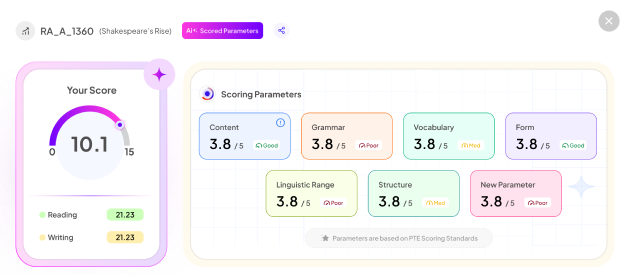
- Kickstart your PTE prep with a free AI-scored mock test
- Boost your score with in-depth analysis & smart recommendations
8. Will speaking fast make me sound fluent?
No, fast speech often reduces clarity. Words blend into each other, endings disappear, and pronunciation becomes unclear. A calm, steady pace works best. Think about explaining something, not finishing it quickly.
9. Can I memorize answers?
Memorizing full answers is risky. You can memorize:
- How to start answers.
- How to structure Describe Image.
- How to organize a Re-tell Lecture.
But memorized sentences often sound unnatural. The system can detect irregular rhythm and repetition patterns. This is why guided practice is safer than scripts.
10. Why are practice scores sometimes higher than exam scores?
This happens for a few reasons:
- The practice platform may not be evaluating speech properly.
- Test-day pressure affects delivery.
- Microphone handling changes.
- Students rely too much on memorized patterns.
Using a platform with updated speaking evaluation logic reduces this mismatch. Gurully’s recent changes focus more on how you speak and what you speak, not just whether you speak.
11. How much should I practice daily?
Practicing longer does not always help. Most students improve faster by:
- Practicing 30–40 minutes.
- Focusing on 1–2 task types.
- Listening to their own recordings.
- Fixing specific pronunciation issues.
Repeating tasks without reviewing feedback rarely improves scores. On Gurully, you will get free question-wise practice of the Speaking section with in-depth analysis. Our speaking scoring is very close to Pearson’s algorithm.
12. Can speaking scores improve in a short time?
Yes, if the focus is correct. Students who already understand English usually see improvement within a few weeks when they stop overthinking grammar and start working on flow and clarity. Consistent practice with accurate feedback makes a noticeable difference.
13. Is silence counted as a mistake?
Yes. Silence breaks fluency. Even if your answer is correct, long silence reduces your speaking score. Pearson follows a 3-second rule in which if your voice is not detected for 3 seconds, the question will automatically pass, and eventually it will reduce your score.
14. Which task affects Speaking score the most?
Repeat Sentence, Summarize Group Discussion has a strong impact because it tests listening, pronunciation, memory, and fluency together.
15. Do fillers like “uh” or “um” matter?
Occasional fillers are normal. Too many fillers reduce fluency. If fillers appear because of nervousness, slowing down slightly usually reduces them naturally.

16. Can any platform predict my real PTE Speaking score?
No platform can predict an exact score. What a good platform can do is show:
- Where pronunciation drops
- Where pauses are too long
- Whether speech rhythm feels natural
Gurully’s updated speaking evaluation focuses on identifying these exact issues so students know what to fix instead of guessing.
17. What happens if I start speaking late after the beep?
If you delay too long after the microphone opens, the system treats it as silence. Silence directly affects fluency. In Read Aloud and Describe Image, you should start speaking within a second or two. Waiting too long to “prepare the perfect start” often costs more marks than starting imperfectly.
A simple rule many students follow: once the mic opens, start speaking calmly, even if the first sentence feels basic.
18. Does pronunciation mean sounding “correct” or sounding “clear”?
Pronunciation in PTE is about clarity, not perfection. You do not need textbook pronunciation. What matters is:
- Words are recognizable.
- Sounds are not merged together.
- Key syllables are stressed correctly.
Many students think pronunciation means sounding like a native speaker. That is not true. Clear speech with a natural accent scores better than forced or artificial pronunciation.
19. Are small pronunciation mistakes penalized heavily?
No small errors are normal and expected. The system does not penalise you for one or two mispronounced words. Scores drop when:
- Many words are unclear.
- Sounds are consistently wrong.
- The listener would struggle to understand the meaning.
This is why practicing difficult sounds and word endings is more useful than worrying about rare or complex words.
20. What if I forget part of a Repeat Sentence?
This happens to almost everyone. If you forget a few words, it is still better to repeat what you remember clearly than to stop completely. Partial answers still receive marks for pronunciation and fluency. Remaining silent or restarting repeatedly causes more damage than missing a word or two.
21. Should I focus on content accuracy in speaking tasks?
Only to a limited extent. In tasks like Describe Image or Re-tell Lecture, content matters, but speaking quality matters more. A well-structured but incomplete answer spoken smoothly often scores better than a content-heavy answer spoken with hesitation. This is why many high scorers keep their answers simple and controlled instead of trying to cover everything.
22. Does repeating the same words reduce my score?
Repetition itself is not a penalty. However, excessive repetition can sound unnatural and may reduce fluency if it causes hesitation. Repeating keywords from the prompt is completely fine. The real issue is repetition caused by uncertainty, not repetition itself.
23. Can background noise affect PTE Speaking scores?
Yes, even low background noise like fans, keyboard sounds, or distant voices can interfere with audio clarity. The system may struggle to isolate your voice if noise is constant. That is why practising in a quiet environment matters. Gurully’s speaking practice helps students notice when background noise is affecting clarity before exam day.

24. Does intonation or expression matter?
Not in the way many students think. You are not scored on emotion or expressiveness. However, flat or robotic delivery sometimes indicates memorization or hesitation, which indirectly affects fluency. Natural rise and fall in speech usually happens automatically when you are speaking comfortably. You do not need to force it.
25. What if I speak with confidence but make factual mistakes?
Factual mistakes do not affect Speaking scores. If your speech is clear and fluent, you will still score well even if the information is not fully accurate. PTE Speaking is not a knowledge test. This is especially relevant in the Describe Image and Re-tell Lecture tasks.
26. Is reading faster in Read Aloud better?
No, reading too fast often leads to:
- Missed punctuation pauses.
- Blurred word endings.
- Reduced clarity.
Reading at a natural pace with correct phrasing usually produces better scores. Think of reading for understanding, not racing through the text.
27. Do punctuation and commas matter in Read Aloud?
Yes, but indirectly. Pausing slightly at commas and stopping at full stops helps maintain natural rhythm. Ignoring punctuation completely can make speech sound rushed or unclear. Over-pausing, however, can reduce fluency. Balance matters.
28. Can stress or nervousness reduce Speaking scores?
Indirectly, yes. Stress often causes:
- Faster speech.
- More fillers.
- Shallow breathing.
- Longer pauses.
These affect fluency and pronunciation. This is why practicing under timed conditions helps reduce anxiety on exam day.
29. Is it okay if my voice sounds low or soft?
A soft voice can be a problem if the microphone does not capture it clearly. The system needs clear audio input. Speaking slightly louder than normal conversation is safer, but shouting is unnecessary. During PTE practice test, always check whether your voice volume is consistent.
30. Does repeating tasks daily actually help?
Yes, if done correctly. Repeating tasks without reviewing feedback does not help much. Improvement happens when you:
- Identify specific pronunciation issues.
- Notice where pauses happen.
- Adjust speed and clarity.
Platforms like Gurully provide feedback that helps you focus on these exact areas instead of practising blindly.
31. What if my voice cracks or sounds shaky during the answer?
A shaky or slightly cracked voice does not directly reduce marks. What matters is whether your words are still clear. This usually happens due to nervous breathing. Slowing down and taking a steady breath before starting helps more than forcing volume or speed.
32. Does smiling or facial expression affect PTE Speaking?
No, the system does not see you. Facial expressions, posture, or eye contact do not affect scoring in any way. Only the audio input is evaluated.
33. Can I stop early if I finish my answer before the time ends?
Yes, you do not need to speak until the timer finishes. If your answer is complete and clear, stopping naturally is fine. However, stopping too abruptly after only a few words may reduce fluency, especially in tasks like Describe Image or Re-tell Lecture.
34. Is repeating the question helpful in speaking tasks?
Repeating part of the question is acceptable, but repeating the full question wastes time and does not add value. In tasks like Answer Short Question, repeating the question often sounds unnatural and can break flow.
35. What happens if I misread a word in Read Aloud?
One or two misread words will not ruin your score. Scores are affected when misreading happens repeatedly or when meaning becomes unclear. If you misread a word, continuing smoothly is usually better than stopping to correct it.
36. Should I change my tone for different tasks?
Not really, all tasks should be spoken in a clear, neutral academic tone. You do not need to sound excited or dramatic. Consistency is more important than expression.
37. Does stress on the wrong syllable affect the pronunciation score?
Occasional stress mistakes are fine. If stress errors happen frequently, especially in common words, pronunciation scores can drop. This is why practising commonly repeated academic words is useful.
38. What if I forget the image details in Describe Image?
You do not need to describe every detail. Focus on:
- One or two main features
- Overall trend or relationship
- Simple comparisons
Clear speech matters more than complete description.
Also Read:
- Everything You Need To Know: PTE Apps & Downloads
- Everything You Need To Know About PTE Score & Result
- Everything You Need To Know About PTE Exam Guide