





You might have decided to take the PTE Exam, but have you decided on your target score? Besides understanding the exam format, you must understand the new PTE Score chart and scoring system that the Pearson Test of English follows. Knowing the PTE Exam scoring system will help you streamline your target.
Adequate preparation for the PTE is crucial to achieving the required scores for university admissions. So, to narrow down your approach, here is a guide to the PTE Exam scoring system 2026. With this insider information, you can tailor your approach while practicing on an AI-scored PTE mock test and confidently approach exam day.
Exam Score Guide & PTE Score Chart 2026
The Pearson Test of English assesses candidates’ Speaking, Writing, Reading, and Listening skills to ensure that they can study in an international environment and have a good grasp of the universal language of English.
Those who are willing to study outside should keep a check on their PTE Academic score. This exam is further segregated in
- PTE Academic
- PTE Core
- PTE UKVI
- PTE Home A1
- PTE Home A2
- PTE Home B1

Mode of PTE Exam Scoring – AI Evaluation
PTE is a completely computer-based exam. The scoring system uses Artificial Intelligence (AI) technology and human experts’ experience and judgment to deliver fast, fair, and accurate scores for every test taker. The PTE test format consists of four sections: Reading, Listening, Speaking, and Writing. Each section is scored on a scale of 10-90, with 10 being the lowest and 90 being the highest. The scoring system rates the answers on correctness/incorrectness, and some answers are scored depending on the quality of the response, such as fluency and pronunciation, content, form, etc.
How Automated Scoring Works:
Speaking & Writing:
Your responses are evaluated by AI for clarity, fluency, grammar, vocabulary usage, and relevance. For example, in Read Aloud, speaking at a steady pace with clear pronunciation matters far more than speaking fast. In Essay Writing, well-structured ideas and clean grammar can easily push your score up, even if your vocabulary is simple.
Reading:
This section tests how accurately you understand written information. In tasks like re-order paragraphs and fill in the blanks, missing even a single keyword can lower the scores. Taking care of vocabulary and logic is crucial in this section.
Listening:
In listening tasks, how well you comprehend the spoken English and give correct responses is evaluated. In tasks like summarizing spoken text, you have to focus on listening and note-taking skills.
How Your PTE Score Card Will Look Like
When you take the test, you’ll receive a detailed new PTE Score Chart that breaks down your performance. This report includes two key sets of scores:
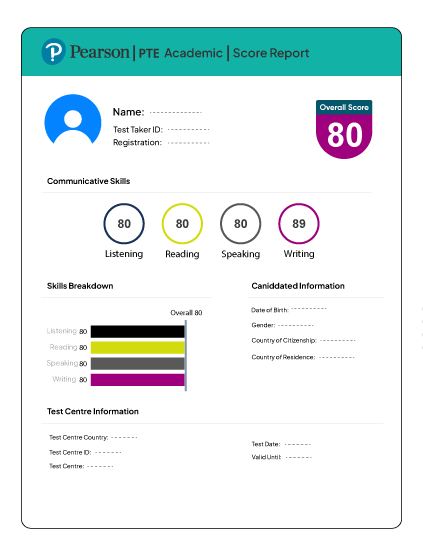
- Overall Score: This number reflects your general English proficiency throughout the test.
- Communicative Skills Scores: These scores delve deeper, showing your strengths and weaknesses in the four key areas of English: Listening, Reading, Speaking, and Writing. Each skill is scored individually, clearly showing your abilities in each domain.
How Each Exam Is Scored
PTE Academic
Score Format :
- The score reflects your overall English proficiency based on your PTE Academic, which is widely accepted for visa, immigration, academic, and professional purposes
- You’ll complete between 52 and 64 tasks, trying out 22 different types of questions.
- Scores range from 10 to 90 points, with higher scores indicating better English skills.
- These scores focus on the four key areas of English: Listening, Reading, Speaking, and Writing.
- Some tasks test multiple skills simultaneously (like reading and speaking together). In these cases, your score for that task contributes to both relevant skills.
How Section-wise & Question-wise Scoring is Done
Scoring is usually done in two ways:
- Right or Wrong: This applies to tasks with clear-cut answers. If you get it right, you get 1 point, and if you get it wrong, you get 0 points. Simple!
- Partial Credit: Here, your score depends on how well you do. A perfect response gets the maximum points, while partially correct answers get some points but less than the top score. This applies to tasks like speaking and writing.
For speaking and writing tasks, scoring goes beyond just being right or wrong. It also considers:
- Content: Assesses how well you answer the prompt with relevant, accurate, and well-developed ideas.
- Development, Structure & Coherence: Evaluates how clearly and logically your ideas are organized, using effective paragraphs and smooth transitions.
- Form: Measures whether your response follows the required format, such as an essay, letter, or summary.
- General Linguistic Range: Assesses your ability to use a variety of sentence structures and expressions effectively.
- Grammar: Evaluates the accuracy of your grammar, including sentence structure, verb tenses, and punctuation.
- Vocabulary Range: Measures the variety and appropriateness of your word choice to communicate ideas clearly and precisely.
- Spelling: Assesses the accuracy of your spelling, as errors can affect the clarity and quality of your writing.
- Oral Fluency: Assesses how smoothly and confidently you speak, with a natural pace and minimal pauses or hesitation.
- Pronunciation: Evaluates how clearly and accurately you pronounce words, including stress, intonation, and overall clarity.
What is the Minimum PTE Academic Score Range for Different Courses?
|
Courses |
Scores |
|
Foundation courses |
Between 36-50 |
|
Undergraduate degrees |
Between 51–60 |
|
Postgraduate degrees |
Between 57–67 |
What to Look in PTE Score Chart For Setting a Target Score
| Score | CEFR LEVEL | English Proficiency Level |
| 85-90 | C2 | Expert |
| 76-84 | C1 | Advanced |
| 59-75 | B2 | Upper-Intermediate |
| 43-58 | B1 | Intermediate |
| 30-42 | A2 | Elementary |
| 10-29 | A1 | Beginner |
CEFR- Common European Framework of Reference for Languages
85-90, CEFR Equivalent: C2
This range indicates you possess the highest level of English proficiency, and it means
- You can understand virtually anything you hear or read with ease.
- You can effortlessly condense information from various spoken and written sources, seamlessly weaving them into a clear and cohesive presentation.
- You can express yourself spontaneously, fluently, and precisely, effortlessly conveying even the subtlest nuances, even in complex situations.
76-84, CEFR Equivalent: C1
This score shows you have very strong English skills, and it means
- You can grasp complex written materials and spoken conversations, even when lengthy or with abstract ideas.
- You can express yourself smoothly and naturally without hesitating for words.
- You can write clear and well-organized texts on complex topics.
The score is great for :
- Australian Skilled Migration Visas: This score meets the English language requirement for these visas.
- University Studies: While not always required for undergraduate programs, this level prepares students for success in academic environments.
59-75, CEFR Equivalent: B2
This score indicates a good proficiency level in the English language & it means
- You can grasp the main ideas of complex texts and conversations, even on technical topics related to your field of study or work.
- You can interact smoothly and spontaneously in everyday situations, expressing yourself clearly and without much effort
- You can produce detailed and clear text on a variety of subjects.
The score is great for:
- University Studies: This level is typically required for undergraduate or postgraduate programs.
- Professional World: Many professions require strong English skills. Scoring in this range shows employers you can communicate confidently in workplace settings.
- Australian Skilled Migration Visas: This score meets the English language requirement for these visas
43-58, CEFR Equivalent: B1
This score demonstrates a developing understanding of English. It might be sufficient for
- Basic Communication
- Simple Interactions
- Personal Expression
While this score might not meet the requirements for most academic programs
30-42, CEFR Equivalent: A2
This level typically falls short of the requirements for most academic coursework. However, it might be suitable for entry into foundation year courses that provide additional language support before entering a degree program.
10-29, CEFR Equivalent: A1
This score indicates a beginner level of English proficiency, similar to the A1 level on the CEFR scale. It’s a great starting point for your English language journey.
Good PTE Score for Studying Abroad or Immigration:
There is no single “perfect” PTE score. A good score always depends on what you’re applying for.
- Study abroad: 65–79+ overall
- Immigration (Canada, Australia, etc.): usually 58–65 overall
- Competitive programs or scholarships: 79–90+ overall
- If you’re applying for Canadian Express Entry, scoring around 65 in each module generally keeps you eligible for most streams.
- Most of the UK universities accept 70-79 overall and high scores in the speaking and writing sections.
- You need to aim for 80+ overall is you are targeting Australian scholarships.
Please note:
Before setting the target score, always check the official website of the universities for the visa program, as it keeps getting changed.
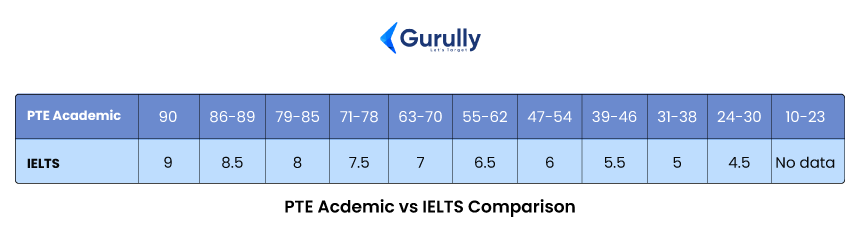
Score Comparison Of PTE Academic With Different Language Proficiency Exam
PTE Core for Canadian PR
Score Format :
- Reflects on your overall English skills based on the entire test.
- You’ll tackle between 49 and 54 tasks, trying out 19 different question types.
- Scores range from 10 to 90, with higher scores indicating better English proficiency.
- Some tasks test multiple skills simultaneously, like reading and speaking or listening and writing. In these cases, your performance contributes to the score of both skills being assessed.
How Section-wise & Question-wise Scoring is Done
The scoring pattern is the same as PTE Academic, For every correct answer, you will get 1, and for the wrong answer, you will get 0. But for partial correct, you will score less than the highest marks.
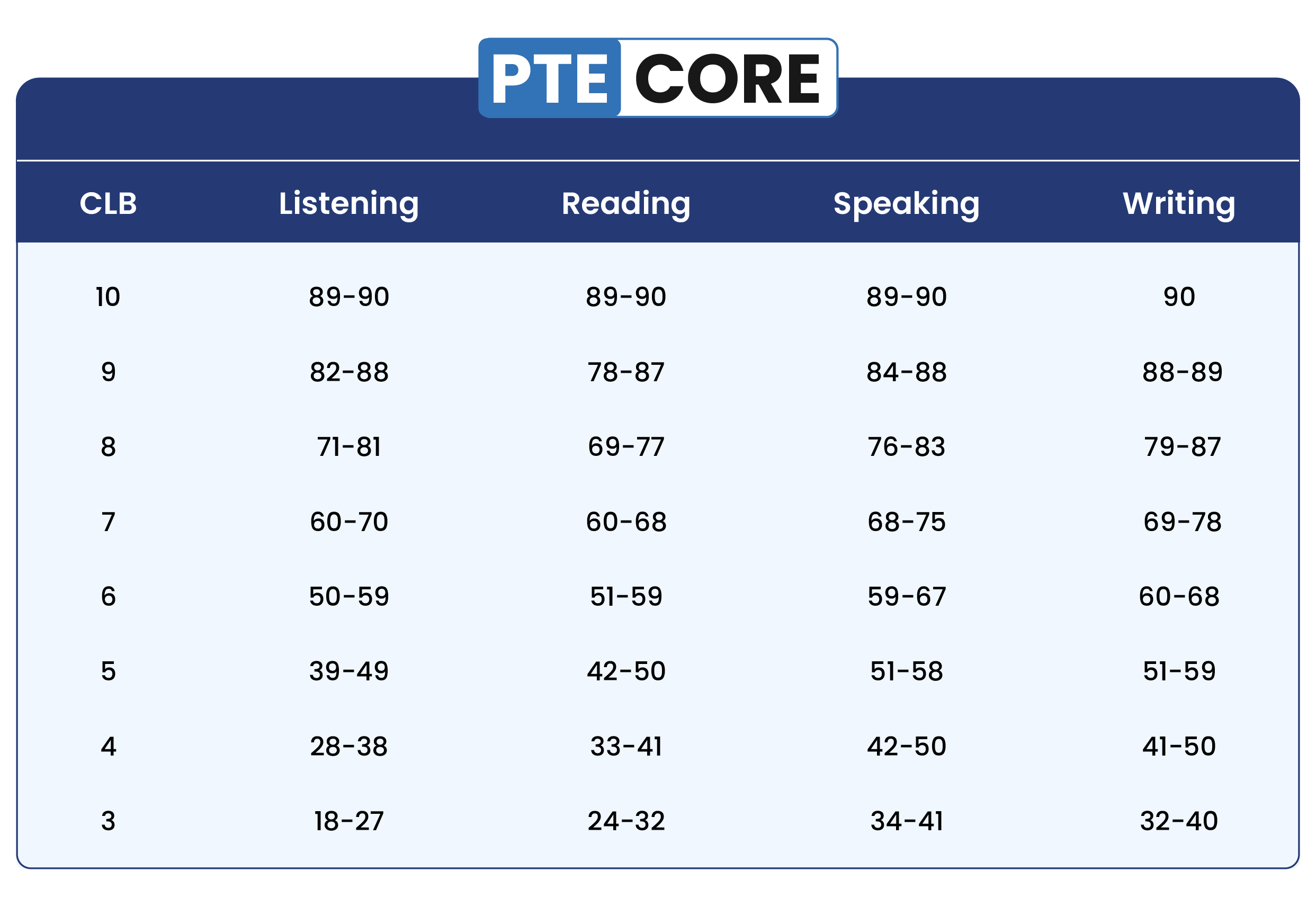
PTE Score Chart to Set Target For PTE Core
This guide explains what English score you need on the PTE Core test (or similar tests) to immigrate to Canada through different programs:
Federal Skilled Worker Program (FSWP):
- This program is for skilled workers (think engineers, software engineers) in high-demand jobs.
- You’ll typically need a strong score (CLB 7) in all four PTE Core skills (reading, writing, listening, speaking) to succeed in these professional roles.
Canadian Experience Class (CEC):
- This program is for skilled workers with recent Canadian work experience.
- The English score you need depends on your job type (called NOC level):
- Management/Professional (NOC 0 & 1): Strong score (CLB 7) in all four skills for complex tasks.
- Technical Jobs (NOC 2): Moderate score (CLB 5) in all four skills for working with instructions and colleagues (e.g., construction workers).
- Supervisor Roles (NOC 3): Basic communication skills (CLB 5 in reading/writing, CLB 4 in listening/speaking) for jobs with less writing (e.g., cooks).
Federal Skilled Trades Program (FSTP):
- This program is for skilled tradespeople (e.g., plumbers and electricians).
- You’ll need a score that shows good spoken English for working with others on-site (CLB 5 in listening/speaking).
- Writing skills are less important, so you’ll need a moderate score (CLB 4) in reading/writing.
How To Prepare for PTE Academic & PTE Core :
- Determine the minimum score required for your chosen program/purpose (e.g., university entry, immigration). This sets a clear target to guide your studying.
- Develop a balanced approach, strengthening your Reading, Writing, Listening, and Speaking abilities.
- Reading: Read various materials (newspapers, articles, books) to enhance vocabulary, comprehension, and skimming/scanning skills. Practice summarizing key points and identifying main ideas.
- Writing: Improve grammar, vocabulary, and writing fluency. Practice writing different text types (essays, summaries, emails) following proper formatting and word count requirements.
- Listening: Immerse yourself in English through podcasts, audiobooks, and movies/TV shows. Practice active listening skills, such as identifying key points, summarizing information, and understanding different accents.
- Speaking: Speak English as much as possible, even to yourself. Record yourself and analyze your fluency, pronunciation, grammar, and vocabulary usage. Consider joining a conversation group or finding a language partner.
- Mock Tests: Take timed practice tests to simulate the real exam environment, identify areas for improvement, build confidence, and refine your time management skills. After each test, use a PTE score calculator to estimate your score, track your progress, and focus your preparation on the sections that need the most improvement.
- Develop Time Management Skills: Practice managing your time effectively during mock tests and while working through practice questions. This ensures you complete all tasks within the allotted time on the actual exam.
- Focus on Weaknesses: Analyze your mock test results and practice materials to identify weaker areas. Dedicate more study time to these areas for targeted improvement.
- Stay Calm and Focused: Relaxation techniques can help manage test day anxiety. Deep breathing exercises and positive self-talk can promote focus and optimal performance.
Who Accepts PTE Scores?
PTE scores are accepted by many institutions around the world, including universities in the United States, Australia, the UK, Canada, and New Zealand. The test is also accepted for visa and immigration purposes in several countries. Candidates can check the official PTE website for a list of institutions that accept PTE scores. This wide acceptance underscores the PTE exam’s credibility and reliability, making it a preferred choice for many aspiring students and professionals.
How To Book PTE Exam :
- Head to the Official PTE Website: Visit Pearson PTE to begin your registration.
- Create Your Account: PTE requires you to register directly through their website. Click the “Create an Account” button and provide the necessary details.
- Find Your Perfect Test Center: With over 400 test centers worldwide, PTE offers a convenient testing location for most. Use the website’s search function to find a center closest to you.
- Schedule Your Exam: Once you’ve chosen your test center, select a date and time that works best for your schedule. PTE offers flexibility to accommodate your needs.
- Double-check and Confirm: Before finalizing your registration, carefully review all your exam booking details, including the test center, date, and time. Make sure everything is accurate to avoid any last-minute hiccups.
How long does it take to get PTE results?
Most of the students opt for PTE because of its timely results. Your result will arrive within 48 hours, and you can directly access it through your registered Pearson account. For example, students who finish the test on Thursday at noon mostly receive the results by Saturday morning. So it is ideal for tight application deadlines.
Note:
It is advised to double-check all the personal details before submitting, as even the smallest error in your name, date, or email can delay your results.
How long are PTE scores valid?
PTE scores are valid for 2 years from the test date. Like if you are giving an exam in January 2027, then the scores will expire in January 2029.
Just knowing the information is not enough. You have to practice for the exam to achieve your target score. Gurully provides an online platform to practice for both PTE Academic & PTE Core. We provide you with a PTE full-length mock test, prediction file, and knowledge zone. Our mock test scoring is powered by AI and a replica of real-time exam simulation. Additionally, you can explore details about the exam fees and practice for PTE exam comprehensively with our resources.
Conclusion:
This blog post is a comprehensive guide to understanding the PTE score chart & scoring system, empowering you to set realistic targets and confidently approach the exam. The PTE exam utilizes a computer-based system leveraging Artificial Intelligence (AI) and human expertise to deliver fast, fair, and accurate scores.
The guide offers a table linking PTE scores to the Common European Framework of Reference for Languages (CEFR) levels. This helps you understand that your target English proficiency level corresponds to PTE Academic & PTE Core, which uses a scoring range of 10-90. The scoring methods (right or wrong and partial credit) remain the same
Your responses are compared against a vast database of past test-taker answers, meticulously scored by human examiners. The detailed scoring guide will help you set the target and streamline your practice.
FAQ:
How much is 6 each in PTE?
Is 65 in PTE a 7?
Is PTE valid for 3 years?
Can I get 70 in PTE?
What is 7.5 in PTE?
Also Read:
- PTE Map Chart – Tips, Template, & Sample Questions With Answers
- Learn 59+ Dictation Words For PTE Exam To Score High