


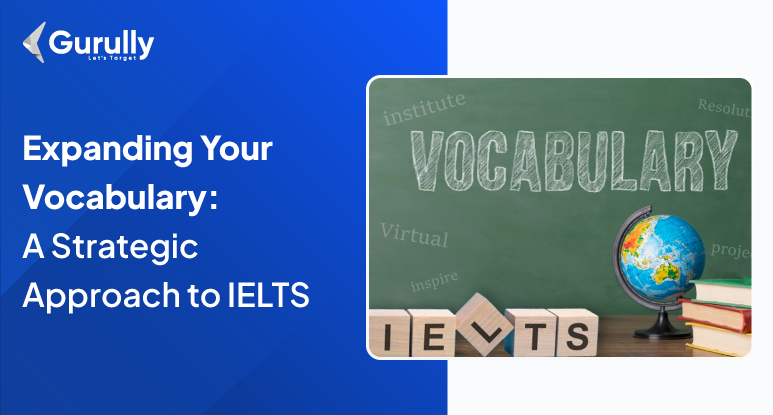
Students often wonder, ‘Why is it vital to have robust vocabulary knowledge for the IELTS exam?’ As IELTS is an English Language Proficiency Exam, a massive focus needs to be given to vocabulary to assess the entire score of a candidate. This exam consists of 4 sections: speaking, reading, writing, and listening, where one thing is common in every area, ‘IELTS vocabulary.’ So, in today’s article, let’s know the significance of vocabulary and how it plays a major role in IELTS exam strategies.
Why is IELTS vocabulary enhancement is vital exam strategy?
A robust vocabulary is undeniably crucial for achieving a high IELTS score. This linguistic arsenal empowers candidates across all four exam components. In the writing and speaking sections, a rich vocabulary is paramount for conveying ideas with precision, nuance, and sophistication. It enables test-takers to articulate complex thoughts effectively and demonstrate a high level of language proficiency. Moreover, a diverse vocabulary is directly linked to higher band scores, as it constitutes a significant portion of the assessment criteria.
Beyond the writing and speaking modules, vocabulary words for IELTS play a pivotal role in listening and reading comprehension. A strong lexical repertoire facilitates efficient processing of information, enabling candidates to identify key details, understand complex ideas, and locate answers accurately. By expanding vocabulary, test-takers can enhance their ability to skim and scan texts effectively, ultimately improving their overall performance in the IELTS exam.
What are the different roles played by vocabulary in other sections?
Vocabulary in the writing section
The IELTS Writing module is a rigorous assessment of your ability to construct coherent and compelling arguments. You’ll be challenged to analyze visual information and express your thoughts clearly, concisely, and accurately. The test demands versatility, as you may be required to shift seamlessly from descriptive tasks, where you interpret visual data, to analytical ones, where you present and justify your opinions. To excel, you must demonstrate a command of language that allows you to articulate your ideas with precision and nuance. A rich vocabulary and a deep understanding of sentence structure are crucial for producing writing that is both engaging and persuasive. By mastering these elements, you can craft well-structured and persuasive responses that leave a lasting impression on the examiner.
Vocabulary for IELTS Writing
| Word | Meaning | Synonyms | Antonyms |
| Mitigate | Reduce something harmful | Alleviate, Lessen, Diminish | Intensify, Worsen, Aggravate |
| Illustrate | Explain with examples | Demonstrate, Clarify, Depict | Confuse, Obscure |
| Implement | Put into action | Execute, Apply, Enforce | Cancel, Abandon, Withdraw |
| Substantial | Large in amount | Significant, Considerable, Major | Minor, Negligible, Small |
| Inevitable | Certain to happen | Unavoidable, Predictable | Avoidable, Preventable |
Vocabulary in the speaking section
The IELTS speaking test is a dynamic assessment of your English language proficiency. Examiners evaluate not only your fluency and coherence but also your ability to think critically and express yourself articulately. A robust vocabulary is indispensable for achieving this. Approximately 20-30% of your overall speaking score hinges on your word choice. By expanding your lexicon, you can convey your ideas with precision, nuance, and sophistication, thereby enhancing your overall performance.
Vocabulary for IELTS Speaking
| Word | Meaning | Synonyms | Antonyms |
| Abundant | Present in large quantities | Plentiful, Ample, Copious, Profuse, Overflowing | Scarce, Sparse, Limited |
| Ambiguous | Not clear or definite | Vague, Obscure, Indefinite, Cryptic | Clear, Explicit, Certain |
| Predominant | Most common or influential | Principal, Dominant, Leading, Prevailing | Minor, Secondary, Inferior |
| Feasible | Possible and practical | Viable, Workable, Realistic, Achievable | Impossible, Unlikely, Impractical |
| Intrinsic | Natural or essential | Inherent, Innate, Fundamental, Built-in | Extrinsic, External, Acquired |
Vocabulary in the reading section
The IELTS Reading module challenges your ability to comprehend and analyze complex texts. You’ll encounter several passages on diverse topics, each followed by a set of questions that assess your understanding. To succeed, it’s crucial to grasp the main ideas and supporting details presented in the passages. By accurately interpreting the information, you can effectively formulate comprehensive and relevant answers to the questions provided. Essentially, the reading section evaluates your capacity to extract meaning from written text and express that understanding clearly and concisely.
Vocabulary for IELTS Reading:
| Word | Meaning | Synonyms | Antonyms |
| Fascinating | Very interesting | Captivating, Engaging, Intriguing | Boring, Dull |
| Ambitious | Having strong goals | Motivated, Driven, Determined | Unmotivated, Aimless |
| Versatile | Able to do many things | Adaptable, Flexible, Multi-talented | Limited, Inflexible |
| Authentic | Real or genuine | Genuine, Original, Legitimate | Fake, Artificial |
| Reliable | Can be trusted | Dependable, Trustworthy, Consistent | Unreliable, Erratic |
Vocabulary in the listening section
The IELTS Listening test presents a multifaceted challenge for non-native English speakers. It demands not only a strong grasp of the English language but also the ability to comprehend a variety of accents and rapidly process information. The test comprises four audio recordings featuring native English speakers discussing a range of topics. Your task is to accurately understand the speakers’ main ideas, specific details, attitudes, and opinions. One of the most significant hurdles lies in the diverse range of accents encountered in the recordings. While familiarity with different accents is crucial, it’s essential to recognize that even native speakers may struggle to understand unfamiliar dialects. The key is to focus on the core meaning of the message rather than getting bogged down by unfamiliar pronunciations. Developing effective listening strategies and consistent practice can significantly enhance your ability to overcome this challenge.
Vocabulary for IELTS Listening
| Word | Meaning | Synonyms | Antonyms |
| Reservation | Advance booking | Booking, Appointment, Hold | Cancellation |
| Refund | Money returned | Reimbursement, Repayment | Charge, Payment |
| Warranty | Product guarantee | Guarantee, Protection plan | No coverage, Expiry |
| Maintenance | Repair or upkeep | Repairing, Servicing | Neglect, Damage |
| Transit | Travel between places | Passage, Transfer | Stay, Stop |
Conclusion
A rich vocabulary is the cornerstone of IELTS success. It empowers you to articulate complex ideas with precision, nuance, and confidence. While self-study can expand your word bank, dedicated IELTS preparation offers a structured approach to mastering the language required for exam excellence.
Gurully’s expert-crafted courses provide a comprehensive vocabulary-building framework. Through immersive learning, you’ll acquire the essential words and phrases to excel in all four IELTS modules. Our training goes beyond mere memorization, teaching you how to effectively use new vocabulary in context.
To complement your learning, our extensive practice tests offer invaluable opportunities to apply your knowledge. Analyze your performance, identify areas for improvement, and gain the confidence to tackle the IELTS with ease.
Don’t let vocabulary limitations hold you back. Take the first step towards IELTS triumph by contacting us today.
FAQ:
How to improve IELTS Reading vocabulary?
Is getting 6.5 IELTS easy?
What is the easiest way to pass IELTS?
Is 4.5 fail in IELTS?
How to get 9.0 in IELTS Speaking?
Also Read:
- Know Difference Between IELTS and PTE Academic – Which is Easier
- Avoid These Top 10 IELTS Myths and Rumors to Score Better