




Starting strong can set the tone for your entire PTE exam! This can be done by the first task, “introduction in PTE”. While it may seem simple, preparing a well-structured and clear introduction can be beneficial. It can help you feel more comfortable and composed for the speaking section. In this blog, we’ll share practical tips, a proven PTE introduction template, and sample answers to help you deliver a smooth and confident introduction that reflects your language skills and professionalism.
What is the Personal Introduction in PTE?
In the PTE exam, the personal introduction is the first task. In this task, you have to read & the prompt in 25 seconds and prepare for it. After doing that, you have 30 seconds to record your statement.
While this section does not contribute to your overall PTE score, the recording is sent to institutions along with your score report. It gives a glimpse of your spoken English skills.
Why is the Personal Introduction Important?
Even though this section does not carry any marks, it serves several purposes:
- First Impression Matters – The institutions that receive your score report may listen to your introduction. It gives them an idea of your English-speaking ability and confidence.
- Prepares You for the Speaking Section – Since this is the first speaking task, it acts as a warm-up, helping you adjust to the test environment and the microphone.
- Boosts Confidence – Speaking fluently and clearly in this section can help ease nervousness and get you comfortable for the more challenging speaking tasks ahead.
PTE Introduction Template:
- Greeting and Name
Always start with a humble and polite greeting and introduce yourself.
- “Hello, my name is [Your Name].”
- “Hi, I am [Your Name].”
- From Where You Are
While answering this question, mention your city and country to introduce yourself briefly.
- “I am from [Your Country/City].”
- “I come from [Your Country], and I currently live in [Your City].”
- Educational Background or Profession
Briefly introduce about your work experiences ( If any) & studies.
- “I have completed my degree in [Your Field] from [Your University].”
- “I am currently working as a [Your Job Title] at [Company Name].”
- Purpose for Taking the PTE Exam
Explain why you are taking the test.
- “I am taking the PTE exam because I plan to study in [Country].”
- “I need this test for my work visa application in [Country].”
- A Ending Statement
End with a positive note.
- “I am excited about taking this test and hope to achieve a great score.”
- “Thank you for listening to my introduction.”

PTE Introduction Sample Answer :
Example 1:
“Hello, my name is Raj Patel. I am from India, and I recently completed my Bachelor’s degree in Computer Science from XYZ University. I am preparing for the PTE exam as I plan to pursue my Master’s degree in Australia. I am excited about this test and hope to achieve a high score to fulfill my academic goals. Thank you.”
Example 2:
“Hi, I am Sarah Johnson, and I come from Canada. I have been working as a marketing professional for the past five years. I am taking the PTE exam as part of my application for a work visa in the UK. I look forward to performing well in this test and advancing my career. Thank you.”
Example 3:
“Hello, my name is Daniel Lee, and I am from South Korea. I hold a Master’s degree in Business Administration and currently work as a financial analyst. I am taking the PTE exam because I intend to migrate to Canada for better career opportunities. I hope to do well and achieve my desired score. Thank you.”
Example 4:
“Hi, I am Maria Fernandez, and I come from Spain. I recently graduated with a degree in architecture and wish to continue my studies in the United States. The PTE exam is essential for my university application, and I am eager to achieve a high score to secure admission to my desired institution. Thank you.”
Tips for a Strong Introduction In PTE
Speak Clearly and Confidently
- Do not speak too fast or too slow.
- Pronounce words correctly
- Do not worry if you make a mistake; continue speaking fluently.
Maintain a Natural Pace
- Try to speak at a constant pace. Do not rush.
- After speaking one sentence, take a natural pose; it will sound natural.
- Avoid long gaps or hesitations.
Keep It Concise and Relevant
- Do not add unnecessary details while introducing yourself. Keep it brief and to the point
- Focus only on important aspects like your name, background, and purpose for taking the test.
- Stick to the 30-second time limit.
Use Formal but Friendly Language
- Speak in a formal and friendly tone.
- Try to avoid casual words like “hey” or “what’s up.” Instead, use “Hello” or “Hi.”
- Don’t use slang or complex vocabulary that might make you stumble.
Practice Before the Test
- Practice by recording yourself on the phone or any other device and listening to it to identify errors.
- Take note of those areas where you can improve clarity, pronunciation, or fluency.
- Practice in a quiet environment similar to the test center or opt for PTE mock tests.
Use Proper Microphone Positioning
- Make sure that your microphone is placed correctly – not too far or too close to your mouth.
- Do not breathe heavily into the mic; it will distort your voice.
 Common Mistakes to Avoid in Your PTE Introduction
- Speaking too fast due to nervousness, which affects clarity.
- Pausing too long or hesitating after the microphone starts recording.
- Using memorized or overly complex sentences that sound unnatural.
- Adding fillers or slang such as “umm,” “like,” or “you know.”
- Giving unnecessary details or talking for too long beyond a simple introduction.

Start your free PTE mock test with Gurully and get AI-powered analysis for a personalized journey.

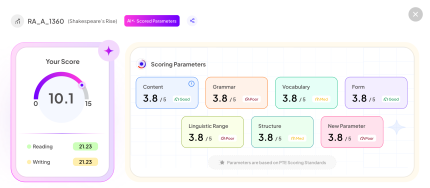
- Kickstart your PTE prep with a free AI-scored mock test
- Boost your score with in-depth analysis & smart recommendations
Although the PTE introduction task doesn’t affect your total score, it remains important to practice. In addition to this, you can also extensively practice other types of questions on Gurully. Our online PTE practice platform provides complete mock tests, sectional assessments, and immediate AI-driven scoring. You can also find free practice questions on our website and via our free mobile application. Keep yourself informed with the newest advice and materials by being part of our Telegram group and subscribing to our YouTube channel.
Conclusion:
Despite having no points, the Personal Introduction section is a crucial element of the PTE exam. It helps you establish a good first impression and boost your confidence for the speaking portion. Working on a concise and clear introduction improves your pronunciation and fluency, creating a positive environment for the rest of the test. Regularly practice on Gurully to strengthen your skills and make a significant difference. To help you perform at your best, Gurully offers full-length practice tests, focused section practice, and instant AI scoring.
FAQ:
How can I introduce myself in PTE?
How to write a PTE essay introduction?
How to get 70 in PTE speaking?
Is 2 weeks enough for PTE?
How much is 7.5 in PTE?
Boost Your PTE Score with These Free Practice Tests
Also Read:
- PTE Speaking Test Questions & Sample Answers For Preparation
- Is PTE Accepted in Germany? A Complete Guide for Test Takers
- PTE Essay Topics You Must Prepare for a High Score