


Preparing for PTE Retell lecture task can be challenging as it requires strong comprehension and summarizing skills. So to help you ace this task, here are the most repeated 20+ PTE Retell Lecture examples. Practice with these PTE retell lecture Questions with answers and understand how to identify key points and structure the response. Besides this, you can also practice for the PTE core and PTE Academic mock test on Gurully to strengthen your fluency and overall speaking skills.
What is PTE Retell Lecture?
In the PTE retell lecture task, you have to summarize what you hear in the audio played. Sometimes, along with the audio, there will also be an image. After the audio ends, you have to re-tell what you heard. In this task, listening and speaking skills are evaluated. Before starting the practice, check the PTE Retell Lecture template and tips, to prepare strategically.
20+ PTE Retell Lecture Examples – Most Repeated
Below are the most repeated PTE retell lecture questions with answers. Practice them and boost your scores in the real exam.
Sample Question 1:
Answer:
The speaker discussed two theories about the formation of gas giants: core accretion and disk instability. Scientists are unsure which is accurate. In laboratories, they simulate high-pressure environments to understand the interiors of gas giants. These planets may have metallic or hydrogen cores. Hydrogen, for example, becomes metallic at extreme pressures. By studying these pressures, researchers hope to learn more about gas giants and similar exoplanets in the universe.
Practice with 30,000+ PTE Questions Now
Sample Question 2
Answer:
The lecture outlined three key points for creating a successful website. First, identify your target audience and their needs. Second, ensure accessibility by linking the site to popular platforms or using social media. Third, encourage user retention by keeping the site updated with useful and relevant content. Grouping users, like researchers or administrators, helps structure the content better. Overall, strategic planning is essential for an effective website.
Sample Question 3
Answer:
The speaker introduced super-symmetry, a mathematical theory aiming to unite matter and force particles. Matter particles include electrons and muons, while force particles are photons and gluons. Super-symmetry suggests a deep symmetry between these two types. Although not yet proven in reality, it’s believed to be the last unconfirmed fundamental symmetry. Scientists are currently investigating if this principle might be active in the universe’s fundamental structure.

Start your free PTE mock test with Gurully and get AI-powered analysis for a personalized journey.

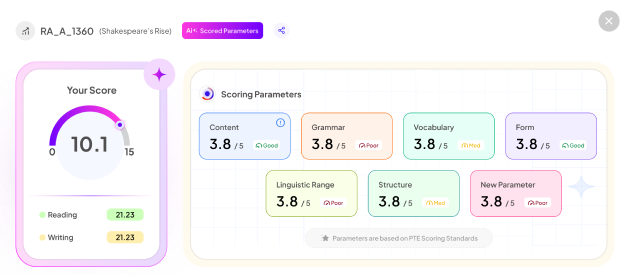
- Kickstart your PTE prep with a free AI-scored mock test
- Boost your score with in-depth analysis & smart recommendations
Sample Question 4:
Answer:
The speaker discussed changes in air pollution since the 1950s. Earlier, smog caused by factories led to serious health problems, including thousands of deaths. Laws like Britain’s Clean Air Act helped reduce this visible pollution. However, modern air pollution is largely from vehicles and is invisible yet harmful. Increased reliance on cars and trucks has made pollution a global issue, requiring continued efforts to protect public health.
Sample Question 5:
Answer:
The speaker explained three philosophical principles for a just city: equity, democracy, and diversity. He emphasized equity over equality, based on philosopher Ross’s idea that policies should benefit the most disadvantaged without worsening their situation. It’s wrong to justify harming vulnerable groups today for potential future benefits. True equity means not exploiting the weakest, even for the so-called greater good. Policies should improve fairness in the present moment.
Sample Question 6:
Answer:
The speaker described conduct disorder in children as a serious, long-term condition marked by aggression, defiance, and legal troubles. Without early help, it can lead to severe adult problems in education, relationships, and employment. Warning signs include poor grades, frequent suspensions, and legal issues. Parents are urged to act quickly, as early intervention can help children learn more positive and adaptive behaviours, reducing the disorder’s long-term consequences.
The main of the things listed in short of ways some of the things can be reduced in short order. Listed ways they will ensure in the serotonin the listed when they were sorted in the communication
Sample Question 7:
Answer:
The speaker highlighted that people often judge art or literature based on personal pleasure. However, in an academic course, emotional enjoyment isn’t enough. Students must develop critical thinking and analysis skills. Even popular content like catchy songs can’t be justified academically by enjoyment alone. While it’s fine to enjoy lighter content, the course focuses on sharpening critical perspectives and learning to evaluate literature in a more structured, thoughtful way.
Sample Question 8:
Answer:
The interview discussed the declining health of the oceans over the last 50 years. The speaker mentioned that around 90% of large fish species like tuna and swordfish have been lost. Human activity has significantly altered ocean life through overfishing and pollution. The damage comes both from what we extract and what we put into the sea or atmosphere. Although grading is difficult, the speaker rated ocean health poorly.
Sample Question 9:
Answer:
The speaker talked about the history and revival of electric vehicles. In the early 20th century, electric cars were more common than petrol ones due to comfort. Later, they declined in use except for specific roles. However, rising oil prices and environmental concerns have renewed interest in electric transport. Trains also adopted electricity early in some countries like Switzerland. Today, electric vehicles are being explored as a cleaner alternative.
Sample Question 10:
Answer:
The speaker discussed architect Frank Gehry’s role in modern architecture. Gehry moved away from traditional straight-line designs to embrace curves and abstract shapes, helped by computer-aided design. His work blurred the line between architecture and sculpture. One famous example is the Guggenheim Museum in Bilbao, which showcases his innovative approach. Gehry’s shift symbolizes architecture as an evolving art form that pushes boundaries through creative freedom.
Sample Question 11:
Answer:
The speaker explained dimensions as independent directions like left-right, up-down, and back-forth. Diagonal movement isn’t new; it’s a combination of existing directions. Dimensions also represent data needed to locate an event. For example, a dinner party address requires three dimensions. According to string theory, reality may have more hidden dimensions, but they’re too small to notice. These extra dimensions are crucial in understanding space and positioning in theoretical physics.
Sample Question 12:
Answer:
The speaker discussed four fundamental forces in the universe. Gravity and electromagnetic force are well-known—gravity keeps us grounded, while electromagnetic force is responsible for electricity and light. The two lesser-known forces are nuclear: the strong nuclear force binds particles inside atoms, and the weak nuclear force causes radioactivity. Together, these four—gravitational, electromagnetic, strong, and weak—govern all physical interactions across the universe.
Sample Question 13:
Answer:
The speaker addressed Britain’s decision to leave the European Union, reassuring both citizens and markets that immediate changes would not occur. Travel, trade, and residency rights remain unchanged for now. The upcoming negotiations will involve all UK nations to protect their interests. The speaker also reflected on achievements during his leadership, including economic growth, welfare and education reforms, and advancing equality and social justice over the past six years.
Sample Question 14:
Answer:
The speaker offered tips for using focus groups in research. An ideal group has six to seven people; too many cause side discussions, too few limit perspectives. A good moderator is essential to guide discussions and ensure equal participation. To encourage focused dialogue, researchers should provide visual materials like photos or graphs. These tools help contextualize the topic and stimulate deeper, more meaningful discussions within the group.
Sample Question 15:
Answer:
The speaker shared that three black hole signals were recently detected. While one was visible with the naked eye, another had lighter black holes with a longer ring-down. With improved sensitivity, scientists expect to detect black hole events daily instead of monthly. This breakthrough will shift observational methods and launch a new field called gravitational wave astronomy, offering deeper insights into the universe’s structure and origins.

Sample Question 16:
Answer:
The speaker emphasized how the internet is transforming language use. It now holds more written content than all libraries combined. The future of any language depends on young people, especially teenagers, who are key to passing it on. To survive, minority languages must engage youth through digital platforms like blogs, chat rooms, and social media. For example, Welsh has gained strength online, showing the internet’s power in preserving language.
Sample Question 17:
Answer:
The speaker explored how writing tools impact style and output. Quill pens led to slow, simple writing. Fountain pens enabled more flowing prose, seen in Dickens’s work. Typewriters encouraged shorter sentences, ideal for journalism. Dictation devices made writing more conversational. These tools influenced how authors structured their work. However, the effect of modern word processors and film on literary style remains a topic for future discussion.
Sample Question 18:
Answer:
The speaker discussed growing criticism of homework, especially for younger children. Though teachers have traditionally assigned it, many doubt its value. Studies show homework has minimal impact on learning and adds stress to families. Not all parents can assist due to time or knowledge. Educators are now shifting toward encouraging children to read for pleasure instead. Reading is considered a more effective and less burdensome learning method.
Sample Question 19:
Answer:
The speaker raised concerns about shrinking internal living space in modern homes. While external space remains unchanged, cramped interiors may harm residents’ mental and physical well-being. Research links overcrowding to stress, illness, and poor educational outcomes in children. Lack of private space can strain family life. Urban planners are encouraged to prioritize individual space inside homes, ensuring residents can live together while maintaining essential personal space.
Do Free Re-tell Lecture Practice with AI Scoring
Sample Question 20:
Answer:
The speaker discussed the historical importance of salt. In ancient times, salt wasn’t just for flavor—it preserved food, allowing it to be stored and transported. Salt was expensive and hard to obtain. Roads to ancient Rome were even built to transport it. In Africa, massive camel caravans crossed the Sahara to deliver salt to markets like Timbuktu. Rulers often raised salt prices to fund wars, showing its high value.
Sample Question 21:
Answer:
The speaker reflected on how biology and mathematics are becoming increasingly interconnected. Though once separate, math now plays a crucial role in biology. For instance, knot theory helps with DNA analysis, and abstract geometry explains viruses. Neuroscience and drug effects can also be modeled with equations. As math influences biology, biologists are encouraged to embrace mathematics as well, recognizing its power to explain complex biological systems.
Sample Question 22:
Answer:
The speaker explains that photography is essential in art history and that art and technology can work together. Photography’s realism pushed artists to explore new perspectives. Although reproductions can’t replace real paintings, some photos feel more emotional and thought-provoking than paintings. The speaker adds that photography still requires creative skill, and even past painters used tools like Vermeer’s camera obscura, before moving to photography’s documentary and cultural value.
Sample Question 23:
Answer:
The speaker discussed research on motivation and how it impacts performance. While financial rewards matter, mindset plays a bigger role. People with a fixed mindset believe talent is inborn, while those with a growth mindset believe effort brings improvement. Mistaking effort for talent can lead to discouragement. Research shows that practice leads to achievement, and changing attitudes towards failure is key for personal and academic success.
Sample Question 24:
Answer:
The speaker traced how the concept of happiness moved from philosophy to psychology, and now into government policy. While governments may seek to maintain peace by promoting well-being, happiness can’t be legislated. Studies show wealth doesn’t guarantee happiness. True happiness often comes from engaging in meaningful activities. Universities now teach happiness, but it remains a personal pursuit, often achieved indirectly through fulfilling and absorbing experiences.
Sample Question 25:
Answer:
The speaker explained Einstein’s revolutionary idea that time is not absolute. According to relativity, time passes differently for observers moving relative to each other. One person’s present might be another’s past or future. Since both views are equally valid, the past, present, and future all exist simultaneously in a real sense. This theory challenges our traditional understanding of time and shows its flexible, relative nature in the universe.
The Gurully AI scoring platform provides PTE retell lecture practice questions that help students score higher. Along with this, you can practice using full-length mock tests and section-wise tests to get a feel of the real exam environment beforehand and build your readiness. With precise, advanced scoring, you can assess your performance effectively and create a PTE study plan tailored to your needs.
FAQ:
What is the best strategy to answer this task?
What are common mistakes to avoid in Re-tell Lecture?
How should I take notes during the lecture?
Is 77 a good score in PTE?
What is the 3-second rule in speaking?
Is 50 in PTE equal to Band 6?
Also Read:
- PTE Exam Pattern 2026 Explained For High Score
- PTE Describe Image Template 2026 – Practice with 50 Examples
- PTE Speaking Tips & Tricks To Score High in 2026 With Vocabulary Guide