



Are you one of those PTE aspirants willing to reach the coveted scores? So, you have to evaluate the PTE Exam’s actual algorithm. Innumerable perceptions exist regarding such PTE’s Artificial Intelligence.
Every contender hustle about achieving the most wanted scores. Truth is, they can reach the target scores by proactively understanding the PTE’s algorithm. But, how could you know all the possible information on PTE’s AI? This article has all the answers to your problems!
Are you curious to take a brief look at PTE’s algorithm? Read the article to get a logical understanding of PTE’s algorithm.
Brief information about PTE’s Artificial Intelligence
On any specifically listed PTE website like Gurully or over the internet, the sole question that everyone keeps asking is, Are there any available sources on the internet that claim to invade the PTE’s real algorithm? The answer is simply “No!”
The major reason is that every examiner is first introduced to the communicative skills and knows the types of questions. But, a few only observe the significance and insights required to understand its enabling proficiencies.
Before getting started, let’s check out what the PTE Exam scorecard holds for you! However, it would be best to stay focused to obtain your targeted scores in Enabling and communicative skills. Follow the top three steps, which are shown below:
Step #1: Understand the significance of enabling proficiencies that affect the Software for Scoring (80%)
The top-notch six enabling skills are there, which are:
Fluency: A clear and consistent voice tone
Grammar: Flawless Grammar while saying more complex sentences
Spelling: Follow the spelling rules while writing
Written Discourse: Appropriate word length and punctuations
Vocabulary: Writing Academic words
Pronunciation: Speak transparently

Step #2: Know all the questions types of communicative skills and concentrate more on associated tasks
There are various modules in the PTE Exam Enabling test, which are:
- Read Aloud– You read a short written passage aloud in a clear and natural voice. This task mainly tests pronunciation, fluency, and reading ability.
- Repeat Sentence-You listen to a sentence once and repeat it exactly as you hear it. This checks listening accuracy, memory, and spoken English control.
- Describe Image– You see an image such as a graph, chart, map, or diagram and describe it. The focus is on organizing information and speaking smoothly.
- Re-tell Lecture– You listen to a short lecture and then summarize it in your own words. This assesses listening comprehension and spoken summarization skills.
- Answer Short Question– You hear a simple question and answer it using one or a few words. It tests listening ability and basic vocabulary knowledge.
- Summarize Written Text– You read a passage and write a single-sentence summary. Your grammar, vocabulary, and ability to capture the main idea are assessed.
- Write Essay– You write an essay of 200–300 words on a given topic. This task evaluates structure, argument development, grammar, and vocabulary.
- Reading & Writing: Fill in the Blanks ( PTE Academics – Fill in the Blanks (Dropdown)– You complete a passage by choosing the correct word from dropdown options. This mainly tests grammar, vocabulary, and contextual understanding.
- Multiple Choice, Multiple Answer– You read a passage and select all answers that are correct. It checks detailed reading comprehension and idea recognition.
- Re-order Paragraphs– You arrange several jumbled paragraphs into the correct logical order. This task measures understanding of coherence and text flow.
- Fill in the Blanks (PTE Academic – Fill in the Blanks Drag and Drop)– You drag and drop words into blank spaces in a reading passage. Vocabulary usage and sentence structure are the key focus areas.
- Multiple Choice, Single Answer– You read a passage and choose the one correct answer. It assesses your ability to identify the main or specific idea.
- Summarize Spoken Text– You listen to an audio and write a summary of 50–70 words. This task checks listening comprehension and written summarization skills.
- Multiple Choice, Multiple Answer– You listen to an audio and select all correct answers. It evaluates your ability to understand multiple points in spoken English.
- Fill in the Blanks (Fill in the Blanks ,Type In – PTE Academic)– You listen to an audio while reading a transcript with missing words. You must type the exact words you hear, testing listening and spelling.
- Highlight Correct Summary– You choose the summary that best matches the audio content. This task focuses on identifying the main idea accurately.
- Multiple Choice, Single Answer– You listen to an audio and select one correct answer. It measures focused listening and understanding of specific information.
- Select Missing Word– You listen to an audio where the last word is replaced by a beep. You choose the word that best completes the sentence logically.
- Highlight Incorrect Words– You read a transcript while listening and click words that differ. This tests attention to detail and simultaneous reading–listening skills.
- Write From Dictation– You listen to a sentence and type it exactly as spoken. It strongly impacts listening, writing, grammar, and spelling scores.
 Important PTE Preparation Tips
- Build familiarity with the test format so you know exactly what each task expects and how scoring works, especially for integrated tasks like Speaking and Writing.
- Practice with high-quality mock tests to improve timing, fluency, and confidence under real exam conditions.
- Strengthen core English skills—listening accuracy, reading speed, speaking clarity, and writing structure—because PTE scoring rewards consistency across all modules.
- Focus on high-weight tasks such as Read Aloud, Repeat Sentence, Describe Image, Re-tell Lecture, and Write Essay, as they significantly influence your overall score.
- Review your performance regularly, identify weak areas, and use targeted practice rather than repeating random questions.
Step #3: Understand how to do software assessment
The software contains more than 10000 writing sample answers. Moreover, it has also preserved over 10000 recorded voices in distinct accents. This software analyzes your writing to a large number of samples. Therefore, again evaluate your score range in terms of the given performance.
In order to grasp better, refer to the example below:
Let’s take the example of two candidates who appeared for PTE writing, where one of the candidates scored 90 and the other one obtained 78. Hence, the first candidate has explicitly mentioned all the complex sentences and also used correct punctuations.
Moreover, he/she may also have maintained the necessary word count. In comparison, the other candidate may have missed out on any of the aforementioned factors. So, this has made the software compare the stored write-ups.
Therefore, the write-up submitted by the second candidate would not have fulfilled the comparison criteria.

Start your free PTE mock test with Gurully and get AI-powered analysis for a personalized journey.

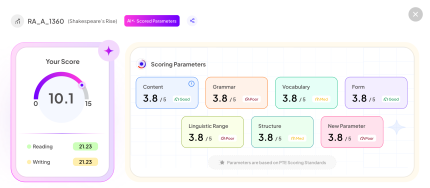
- Kickstart your PTE prep with a free AI-scored mock test
- Boost your score with in-depth analysis & smart recommendations
The Final Say
It is expected that the article is helpful enough to mitigate your curiosity based on understanding the PTE fundamentals and also the algorithm. Do you want to gain more insightful knowledge about the PTE exam and the algorithm? You may turn to the best AI-enabled PTE exam practice platforms, like Gurully, in order to study well for your PTE examination.
FAQ:
What is the PTE exam?
Is PTE exam easier than IELTS?
What is the cost of PTE exam?
How much is 7.5 in PTE?
Is 70 a good PTE score?
Also Read:
- PTE Accepted Universities In USA
- PTE Reading Multiple Choice, Multiple Answer – High Scoring Tips
- Introduction In PTE – Things You Need To Know For Making A Strong Impression