




While preparing for the PTE exam, one of the most important things that you should be aware of is collocations. As the exam has 4 sections and various tasks, knowing only a few words is not enough. To achieve your target score, you must elevate your fluency and accuracy by understanding how words pair. And to help you with that, here is a list of collocations for PTE. This list can also be used while practicing with the PTE exam practice test.
Collocations are not only vocabulary tricks but patterns that help you sound more academic, more fluent, and more confident. When you have a strong grip on them, you will be able to score high
What Are Collocations?
A collocation is a natural combination of words that native speakers commonly use together.
Examples include:
- Make a decision (not do a decision)
- Conduct research
- Strong evidence
- Rapid development
English is full of these fixed pairings. You can know every word in a sentence and still sound unnatural if the combinations are off.

Start your free PTE mock test with Gurully and get AI-powered analysis for a personalized journey.

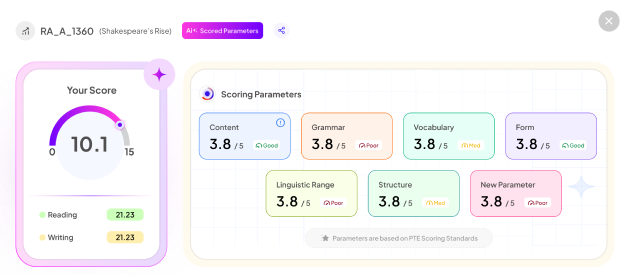
- Kickstart your PTE prep with a free AI-scored mock test
- Boost your score with in-depth analysis & smart recommendations
Why You Need Collocations For PTE:
Mastering collocations directly improves your performance in all four modules. Here’s how:
- Speaking
- Makes your speech smoother and more natural.
- Helps reduce fillers because word combinations come to you as ready-made chunks.
- Improves pronunciation rhythm because collocations carry natural stress patterns.
- Writing
- Increases lexical range.
- Helps create clear, formal, academic-style sentences.
- Boosts coherence and reduces repetitive word choices.
- Reading
- Makes gap-fill questions easier because you can predict missing words.
- Helps you quickly identify combinations that “sound right”.
- Saves your time by finding key elements.
- Listening
- Through this, you can process academic phrases faster.
- You can easily identify meaningful information in spoken text.
- Helps you understand a wide range of vocabulary.
List of Collocation Words for PTE
This list is useful for PTE because the exam uses academic language throughout its tasks.
List of Collocation Words for PTE Speaking:
| Categories | Collocations |
| Academic Functions | conduct research, draw conclusions, raise concerns, reach a consensus, address an issue, assess the impact, evaluate performance, establish a relationship |
| Describing Trends & Data | a steady rise, a sharp decline, noticeable fluctuations, remains stable, peaks at, plateaus around, shows an upward trend, indicates variation |
| Explaining Visuals | the image illustrates, the chart demonstrates, the diagram represents, the figure highlights, the table reveals, the graph suggests, it can be inferred that |
| Lecture Summary Language | the speaker argues that, one key point mentioned, the lecture emphasises, the presenter explains, another aspect discussed was, it is evident that |
| Science & Technology | technological advancement, energy consumption, environmental sustainability, digital innovation, scientific discovery, renewable sources, computational accuracy |
| Problem–Solution Patterns | identifies a problem, proposes a solution, addresses challenges, presents an alternative, outlines key issues, recommends measures |
| Comparative Language | in contrast to, similar to, unlike the previous point, a comparable pattern, differs significantly, follows the same trend |
| Summarising & Concluding | in summary, the overall trend shows that, to conclude, the main idea is, essentially, the key takeaway is |
List of Collocation Words for PTE Writing:
| Categories | Collocations |
| Argument & Opinion | it is widely believed that, some experts argue that, a common assumption is that, there is growing concern that, critics claim that, researchers suggest that |
| Cause & Effect | leads to, results in, is triggered by, contributes to, is responsible for, plays a decisive role in, stems from |
| Academic Precision & Clarity | in accordance with, from a theoretical perspective, under certain conditions, through systematic analysis, at a conceptual level |
| Contrast & Comparison | in contrast, on the other hand, differs significantly, similarly, in comparison with, in a broader context |
| Persuasive Writing | strengthens the argument, supports the claim, provides substantial evidence, challenges traditional views, reinforces the point |
| Summarisation Collocations (SWT) | the passage emphasises that, the author illustrates how, the central theme revolves around, the writer concludes that, the text highlights |
| 7. Academic Quantity & Extent | to a large extent, in considerable amounts, a significant portion, a minimal impact, substantial growth, a rapid increase |
| Problem–Solution Writing | addresses the issue of, proposes a solution to, mitigates potential risks, tackles the challenge of, overcomes limitations |
List of Collocation Words for PTE Reading:
| Categories | Collocations |
| Verb + Noun | make progress, take responsibility, gain insight, draw attention, reach agreement, meet expectations, impose restrictions, propose solutions |
| Adjective + Noun | significant difference, rigorous analysis, fundamental principle, widespread recognition, inherent value, major concern, notable achievement |
| Noun + Noun | resource management, behavioural patterns, climate change, policy framework, decision-making process, economic transition |
| Preposition Collocations | in light of, in comparison to, in favour of, at odds with, on behalf of, in response to |
| Logical Flow & Sequencing | subsequently, initially, meanwhile, therefore, nevertheless, moreover, furthermore, consequently |
| Academic Concepts | theoretical framework, empirical evidence, conceptual clarity, methodological approach, historical perspective, analytical reasoning |
| Research & Data Language | survey results, statistical analysis, empirical observation, experimental design, data interpretation |
| Relationship & Contrast | highly dependent on, closely associated with, directly linked to, stands in contrast to, strongly related to |

List of Collocation Words for PTE Listening:
| Categories | Collocations |
| Education & Society | academic excellence, community engagement, demographic changes, social inequality, cultural influence, behavioural development |
| Business & Economy | operational efficiency, financial uncertainty, economic expansion, market fluctuations, revenue generation, strategic investment |
| Environment & Science | ecological balance, carbon neutrality, conservation efforts, pollution levels, biodiversity loss, environmental impact |
| Lecture Explanation Patterns | the speaker refers to, according to the lecturer, one example mentioned, a major factor discussed, the main argument presented |
| Cause–Effect in Lectures | is caused by, leads to, results from, contributes to, brings about, is influenced by |
| Academic Concepts & Theories | theoretical model, core hypothesis, underlying assumption, supporting evidence, historical context, practical application |
| Research & Discovery Language | recent findings, scientific exploration, ongoing experiments, technological innovation, data-driven insights |
| Problem–Solution Lectures | addresses the issue of, suggests an alternative, proposes a strategy, identifies challenges, recommends actions |
How to Use Collocations in PTE Preparation
- Learn Collocations by Category
Instead of memorizing random pairs, group them by themes commonly seen in:
- Education
- Environment
- Technology
- Health
- Economy
- Social issues
This helps you recall relevant phrases during speaking and writing.
- Practice Using Them in Sentences
Active usage matters. Try incorporating 10–15 collocations weekly into:
- Short essays.
- Describe Image responses.
- Retell Lecture practice.
- Mock PTE essays.
- Revise Regularly
Create a small notebook — digital or physical — where you list:
- The collocation.
- Meaning.
- One sample sentence.
- Reviewing them in chunks helps build natural recall.
- Apply Them in Fill-in-the-Blank Practice
- Most blanks in PTE Reading & Listening rely on collocational knowledge.
- This means consistent exposure significantly boosts your accuracy.
- Use Collocations to Extend Your Speaking Responses
Collocations for PTE become more effective when you embed them inside longer, meaningful phrases.
Examples:
- “a significant increase in population growth”
- “a steady decline in pollution levels”
- “a major challenge for modern societies”
Using these naturally in Describe Image, Retell Lecture, and Long Answer questions adds fluency, clarity, and better rhythm to your speech.
You can use this list of collocations for PTE while doing mock test practice. Take advantage of unlimited free PTE practice questions and strengthen your individual task. Our full-length mock tests are created by experienced PTE trainers and mirror the real test format closely, giving you a clear sense of what the actual exam feels like. For more tips, strategies, and useful insights, join our Telegram community and subscribe to our YouTube channel.
FAQ:
What is the PTE collocation list?
What are the conjunctions in PTE?
How to get 79+ in PTE writing?
How to get 100% on an essay?
Is 2 weeks enough for PTE?
Also Read:
- PTE Score Changes for Australia Visa- Updated Requirements Explained
- PTE Mock Test vs Practice Questions – What’s Better for You?
- Top 10 Free PTE Practice Websites To Help You Score 79+
Do Free PTE Exam Practice